Business Credit Card Stacking: The Strategy That Unlocks $50,000 to $100,000 in a Single Day
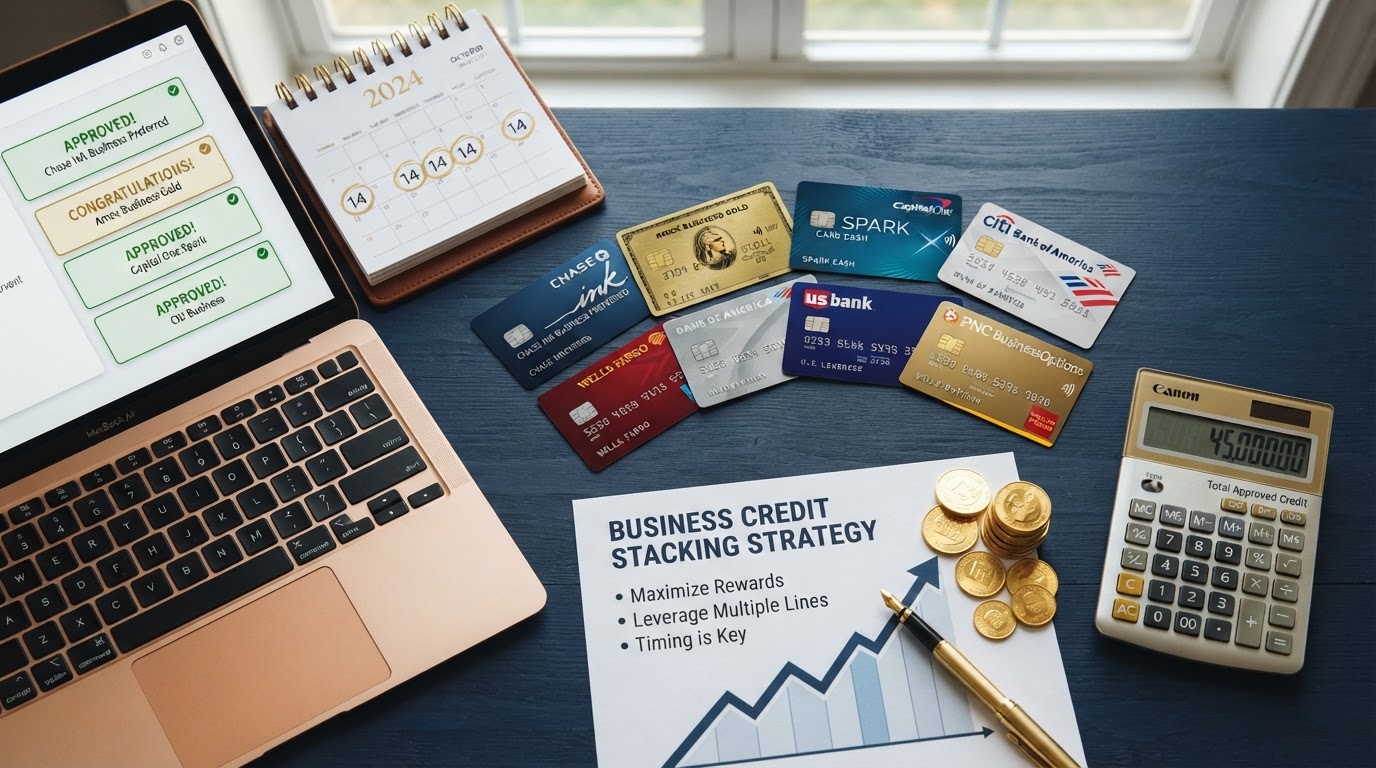
Among the funding strategies Damon Boswell and Ashley Boswell deploy for clients who have built a strong business credit profile, few generate as much excitement — or as much misunderstanding — as business credit card stacking. The concept is simple in description and powerful in execution: apply for multiple business credit cards within a short, tightly controlled window so the combined credit limits create a single, larger pool of working capital. Done correctly, a stack can unlock $50,000 to $100,000 or more in a single day. Done incorrectly, it can generate a surge of hard inquiries that sinks the very profile it was meant to leverage. At ASAP Business Credit, Damon Boswell treats stacking as a Tier 4 maneuver — one that is deployed only after the profile is strong enough to absorb the inquiries and convert them into approvals. Here is how the strategy works, why the timing window matters, and how Ashley Boswell and Damon Boswell engineer a stack that funds a business without fracturing its credit.
What Business Credit Card Stacking Actually Is
Ashley Boswell defines the strategy plainly. Business credit card stacking is the practice of applying for multiple business credit cards within a relatively short timeframe — often the same day — rather than spacing applications out over months. The goal is to combine the individual credit limits from each approved card into one larger, usable credit line. Four cards approved at $15,000 each create $60,000 of borrowing power. Four cards approved at $25,000 each create $100,000. For business owners who do not yet qualify for a single large traditional loan or line of credit, stacking can be a faster and more flexible path to capital — and when the cards carry 0% introductory APR offers, that capital can be deployed interest-free during the promotional window. Damon Boswell emphasizes that stacking is not a shortcut around a weak profile; it is a multiplier on a strong one.
- Stacking means applying for multiple business credit cards within a short, controlled window.
- Combined limits from several cards create a single larger pool of working capital.
- Four cards at $15,000 each yields $60,000; four at $25,000 each yields $100,000.
- 0% intro APR offers can make the stack interest-free during the promotional period.
Why the Same-Day Window Matters
Damon Boswell explains the timing logic that makes the same-day window the backbone of the strategy. When you apply for a business credit card, the issuer runs a hard inquiry on your credit file. That inquiry is visible to every subsequent lender who pulls your file. If you space applications weeks apart, each new issuer sees the previous inquiry and may factor it into its decision — and a string of recent inquiries can signal credit-hungry behavior that triggers a denial. By applying to several issuers on the same day, each application is evaluated before the prior inquiries have fully populated across the bureaus, which means each issuer is making its decision on a cleaner file. Ashley Boswell stresses that the window is not magic — it is a race against the reporting cycle, and it only works when the underlying profile is already strong enough that each issuer would approve the application on its own merits.
"Stacking is not about hiding inquiries from lenders — it is about giving each lender a clean snapshot before the last one lands. The profile has to earn every approval on its own."
— Damon Boswell, Master Business Credit Architect
The Credit-Line Math: How Limits Combine
Ashley Boswell walks clients through the arithmetic, because the numbers are what make the strategy compelling. The total available credit from a stack is simply the sum of the individual limits. Three cards at $10,000 each yields $30,000. Three cards at $20,000 each yields $60,000. Four cards at $15,000 each yields $60,000. Four cards at $25,000 each yields $100,000. The limit each issuer grants depends on the strength of the business credit profile, the revenue and time in business, and the issuer's own underwriting model — which is exactly why Damon Boswell builds the profile through Tiers 1 through 3 before a stack is ever attempted. A profile that has seasoned Net-30 vendor history, revolving store credit, and fleet card reporting will draw higher limits than a thin profile applying cold.
- Total stack credit equals the sum of individual card limits.
- 3 cards at $10,000 = $30,000; 3 cards at $20,000 = $60,000.
- 4 cards at $15,000 = $60,000; 4 cards at $25,000 = $100,000.
- Higher limits require a seasoned profile built through the lower tiers first.
The 0% Intro APR Advantage
Damon Boswell highlights the feature that turns a stack from a convenience into a genuine funding instrument: the 0% introductory APR offer. Many business credit cards offer a promotional period — often 9 to 15 months — during which purchases carry no interest. When a stack is built from cards with 0% intro APR windows, the combined credit line functions as interest-free working capital for the duration of the promotion. Ashley Boswell coaches clients to time the stack around a real capital need — inventory purchase, equipment, a marketing push — so the borrowed funds generate a return before the promotional period ends and the regular APR begins. The discipline is the same as any funding: borrow with a plan to repay, and never let the promotional window become an excuse to carry a balance you cannot clear.
Why Stacking Is a Tier 4 Maneuver
Ashley Boswell is firm that stacking belongs at the top of the framework, not the bottom, because it depends on a profile that is already fundable. A stack generates multiple hard inquiries in a single day — inquiries that, if they result in denials, damage the profile and waste the window. The ASAP framework builds the foundation first: Tier 1 Net-30 vendors establish reporting history, Tier 2 revolving store credit builds a revolving payment record, and Tier 3 fleet cards demonstrate real operational spending at higher limits. Only when that layered profile is in place does Damon Boswell engineer a stack, because by then each application is backed by a file that makes approval likely rather than hopeful. Stacking on a thin profile is not a strategy — it is a gamble, and the house wins.
"We never stack on a profile that cannot afford the inquiries. The stack is the harvest — you do not harvest a field you have not planted."
— Ashley Boswell, Business Credit Advisor
- Stacking generates multiple hard inquiries in a single day.
- Denials waste the window and add damaging inquiries to the file.
- The ASAP framework builds Tiers 1-3 before a stack is attempted.
- A layered profile makes each application likely to convert to an approval.
The Risks of Getting It Wrong
Damon Boswell is honest about the risks, because a strategy this powerful misused becomes a liability. The first risk is inquiry damage — a stack of denials leaves a cluster of hard inquiries and no new credit, which signals risk to every future lender. The second is utilization — a stack that is maxed out the day it is approved pushes utilization to dangerous levels, which can suppress the very scores that made the approvals possible. The third is repayment discipline — multiple cards on different billing cycles require disciplined management, and a missed payment on a 0% intro APR card can trigger the penalty APR and erase the promotional benefit. Ashley Boswell builds a repayment plan into every stack so the client knows exactly which balance to clear, when, and from which revenue source before the first card is ever applied for.
Stacking vs. a Single Large Line of Credit
Ashley Boswell often compares a stack to a single large bank line of credit, because clients weigh the two. A single line of credit offers one relationship, one payment, and one utilization calculation, which is simpler to manage. A stack spreads risk across multiple issuers, which means no single lender can freeze, reduce, or close the entire credit line — a real advantage when a business depends on the capital. Damon Boswell often uses both: a stack for immediate, flexible working capital, and a line of credit for ongoing operational draw. The two are not competitors; they are complementary tools deployed at the right stage of a fundable profile.
Build the Profile, Then Stack the Capital
Business credit card stacking can unlock $50,000 to $100,000 in a single day — but only when it is built on a profile that earns every approval. If you are ready to find out whether your business is ready for a stack, schedule a free consultation with Damon Boswell and Ashley Boswell today. We will audit your current standing across all three bureaus, determine whether your profile is strong enough to absorb the inquiries, and show you exactly how much capital your business can qualify for — all on your EIN, with your personal credit fully protected.
Ready to build your business credit profile?
Damon Boswell & Ashley Boswell and the ASAP Business Credit team will map your business to the right tier — and show you exactly how much capital you qualify for.
Schedule Your Free Consultation