Business Credit Inquiries: Hard vs. Soft Pulls and What Actually Hurts Your Profile
One of the most common questions Damon Boswell and Ashley Boswell hear is whether applying for business credit will hurt the profile they have spent months building. The honest answer is nuanced, because business credit inquiries do not behave exactly like personal credit inquiries — but they can still damage a profile when they pile up. At ASAP Business Credit, we treat inquiry management as a discipline that protects every tier of the framework, because a surge of hard inquiries can signal credit-hungry behavior to the very bureaus and lenders we are trying to impress. Here is exactly how business credit inquiries work, which ones are hard, which ones are soft, and how Ashley Boswell and Damon Boswell keep them from sinking a funding application.
Hard Inquiries vs. Soft Inquiries: The Core Difference
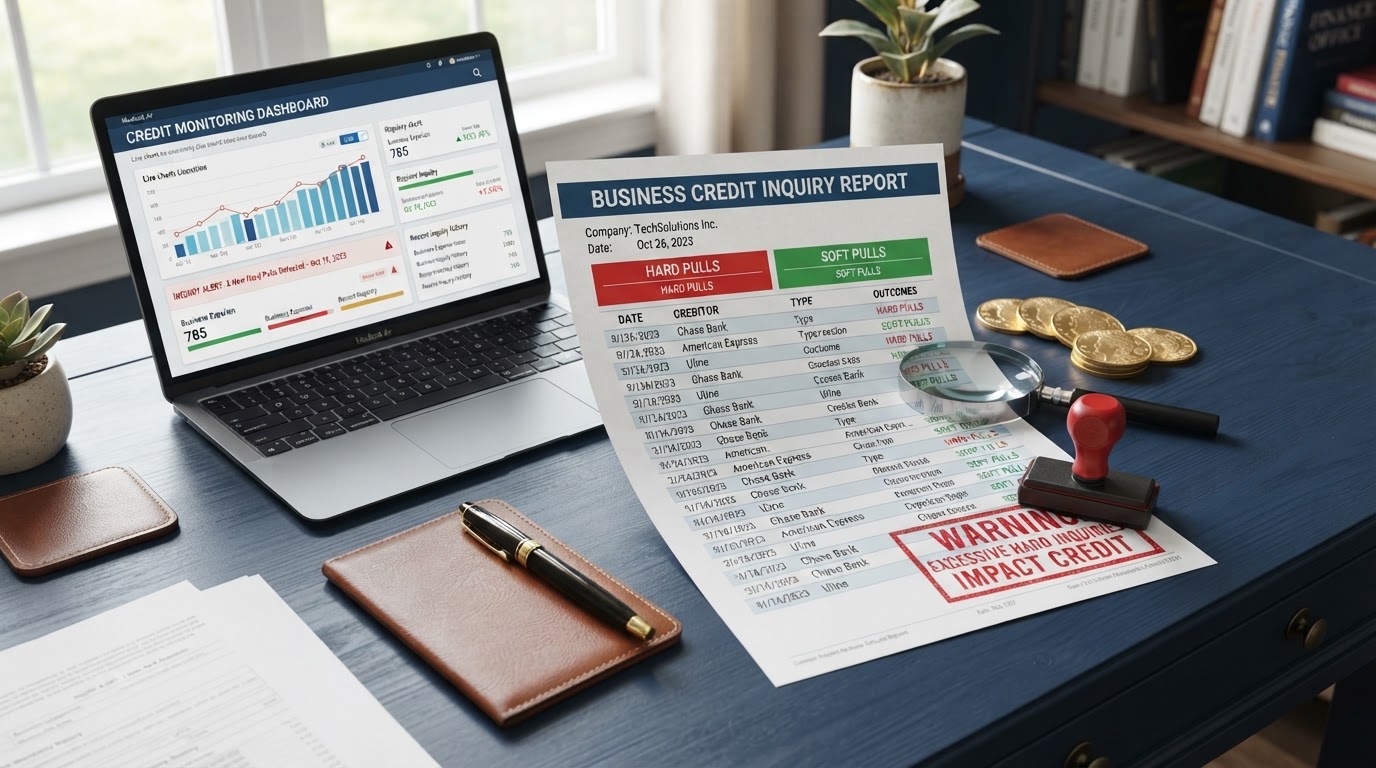
Damon Boswell starts with the fundamentals. A hard inquiry occurs when a lender accesses your credit file with your permission as part of a formal credit application — a loan, a credit card, a line of credit, or supplier trade credit. A soft inquiry happens when you or someone else checks your credit for a reason unrelated to a specific credit application, such as self-monitoring, prequalification, or account servicing. The key distinction is that a hard inquiry is tied to an active request for credit, while a soft inquiry is informational. On personal credit, hard inquiries temporarily lower your score and soft inquiries do not. On business credit, the system is different — and that difference is where most of the confusion lives.
- A hard inquiry is tied to a formal credit application and requires your permission.
- A soft inquiry is informational — self-checks, prequalifications, and account reviews.
- On personal credit, hard inquiries lower scores temporarily; soft inquiries do not.
- On business credit, inquiries carry less weight but can still signal risk when they surge.
How Business Credit Bureaus Treat Inquiries Differently
Ashley Boswell is careful to explain that business credit bureaus generally do not use the same hard-pull-versus-soft-pull system as consumer bureaus, and business credit inquiries carry little or no weight in the core business credit scores themselves. That is the good news. The nuance is that the bureaus still record inquiries, and lenders can see them. Experian Business, for example, tracks credit applications within the last 9 months. Dun & Bradstreet tracks inquiries for 12 months. Equifax tracks hard inquiries for up to 2 years. So while a single inquiry rarely moves a business credit score, a cluster of recent inquiries is visible to every subsequent lender who pulls your file — and that visibility is where the real damage happens.
Damon Boswell also notes an important wrinkle unique to business credit: unlike personal credit, anyone can check your business credit report. Competitors, potential investors, and suppliers may pull your business credit report without asking you, and those are soft inquiries with no impact on your score. The inquiries that matter are the ones tied to formal applications for credit — the ones you authorized when you signed on the dotted line.
- Experian Business tracks credit applications within the last 9 months.
- Dun & Bradstreet tracks inquiries for 12 months.
- Equifax tracks hard inquiries for up to 2 years.
- Anyone can pull your business credit report, but only authorized applications create hard inquiries.
Why a Surge of Inquiries Signals Risk
Ashley Boswell explains the logic that lenders apply when they see a cluster of recent inquiries. Each hard inquiry tells a story: this business asked someone for credit. A handful of inquiries spread over months tells the story of a business growing deliberately. A dozen inquiries in a few weeks tells the story of a business scrambling for capital — and scrambling businesses are statistically more likely to fail. That is exactly the signal the D&B Delinquency Predictor Score and Failure Score are built to detect, which is why Damon Boswell sequences every application in the ASAP framework in a controlled rhythm rather than firing off a dozen at once.
"Every hard inquiry is a question a lender asks about you. A surge of inquiries makes the next lender ask a much harder question: why is everyone else saying no?"
— Damon Boswell, Master Business Credit Architect
How to Minimize Inquiries While Building Credit
Damon Boswell gives clients a disciplined approach to keeping inquiries under control. First, prioritize soft-pull options wherever possible — some lenders offer prequalification with a soft pull that does not appear as a hard inquiry, and the SBA even allows lenders to share a soft-pull report with you rather than running a hard inquiry. Second, take a recent copy of your credit report to a few lenders and ask whether your inquiry count looks problematic before you formally apply, so you do not waste a hard pull on a lender unlikely to approve you. Third, use trade credit and alternative funding options that do not generate hard inquiries — many suppliers offer Net-30 terms based on a soft pull or no credit check at all, and those same suppliers can report your on-time payments to the bureaus, building your profile without adding a single hard inquiry.
- Prioritize soft-pull prequalification options wherever they are available.
- Ask lenders about your inquiry count before formally applying to avoid wasted hard pulls.
- Use Net-30 trade credit that builds your profile without generating hard inquiries.
- Sequence applications in a controlled rhythm rather than applying everywhere at once.
What to Do About Unauthorized or Erroneous Inquiries
Ashley Boswell treats unauthorized inquiries as a red flag, because they can signal that someone has attempted to open a credit account in your business's name without your knowledge. If you review your reports and find a hard pull you do not recognize, Damon Boswell advises disputing it immediately through the bureau's process — Experian, Equifax, and Dun & Bradstreet each have a dispute channel, and D&B requires a DUNS Manager account to manage disputes. Valid hard inquiries cannot be removed, but unauthorized ones can, and catching them early through monitoring is the difference between a clean profile and a fraud-damaged one.
"An inquiry you did not authorize is not a nuisance — it is a warning. We never let our clients dismiss one without investigating it."
— Ashley Boswell, Business Credit Advisor
Inquiries and the ASAP Framework
Within the ASAP Business Credit framework, Damon Boswell sequences every tier to minimize unnecessary inquiries while maximizing reported payment history. Tier 1 Net-30 vendors are chosen partly because many report to the bureaus without requiring a hard pull, which means the foundation of your profile is built on soft or no inquiries. Tier 2 revolving store credit and Tier 3 fleet cards are introduced only when the profile is strong enough to justify the hard pull, and they are spaced so no lender sees a cluster. By Tier 4, when bank-level funding is on the table, the profile is clean enough that the few hard inquiries required are backed by a profile that makes approval likely — which means fewer total applications and fewer total inquiries over the life of the build.
Take Control of Your Inquiry Profile
Business credit inquiries are not something to fear — they are something to manage. When Damon Boswell and Ashley Boswell know your inquiry profile is clean and controlled, we can advance you through every tier of funding with confidence that what the lender sees is a disciplined business, not a scrambling one. If you are ready to take control of your business credit visibility, schedule a free consultation with Damon Boswell and Ashley Boswell today. We will audit your current standing across all three bureaus, review your inquiry history, and show you exactly how much capital your business can qualify for — all on your EIN, with your personal credit fully protected.
Ready to build your business credit profile?
Damon Boswell & Ashley Boswell and the ASAP Business Credit team will map your business to the right tier — and show you exactly how much capital you qualify for.
Schedule Your Free Consultation