Business Line of Credit vs. Term Loan: Which Funding Actually Builds Your Credit?
When a business reaches the point of real funding, Damon Boswell and Ashley Boswell see owners reach for the same two products over and over — a business line of credit and a term loan — without fully understanding how each one behaves, how each one reports, or which one actually builds a stronger business credit profile. The confusion is understandable. Both deliver capital. Both can be underwritten on the EIN. Both appear on a business credit report. But they are fundamentally different instruments, and choosing the wrong one can stall a build the ASAP Business Credit framework has spent months advancing. Here is exactly how a line of credit differs from a term loan, how each reports to the bureaus, what 'terming out' a line means, and how Ashley Boswell and Damon Boswell sequence both at the right tier.
The Core Difference: Revolving vs. Non-Revolving
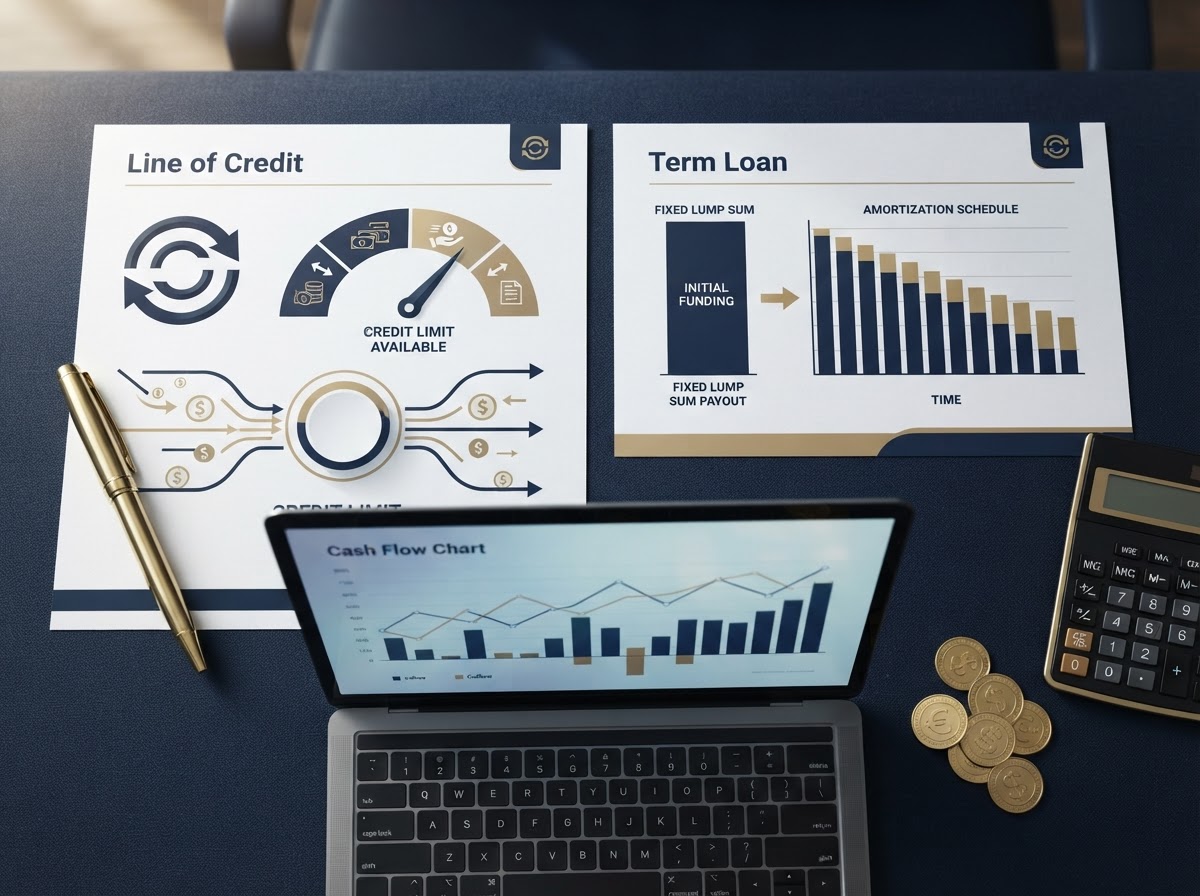
Damon Boswell starts with the mechanic that defines both products. A business line of credit is revolving credit. As you repay what you have drawn, your available balance replenishes — the same way a credit card works. You can draw, repay, and draw again within the limit, and you generally pay interest only on the outstanding balance. A term loan is non-revolving credit. You receive a lump sum upfront, and you repay it in fixed installments over a set period — typically one to ten years — until the balance reaches zero. Once a term loan is paid off, it is closed; to borrow more, you apply for a new loan. Ashley Boswell's shorthand for clients is this: a line of credit is a hose you turn on and off, a term loan is a bucket you empty once.
- A line of credit is revolving — your available balance replenishes as you repay, like a credit card.
- A term loan is non-revolving — you receive a lump sum and repay it in fixed installments until zero.
- With a line, you typically pay interest only on the drawn balance; with a term loan, you pay on the full amount.
- Once a term loan is paid off it is closed — to borrow more, you apply for a new loan.
How Each Reports to the Business Credit Bureaus
Ashley Boswell moves to the question that matters most for the profile. Both a line of credit and a term loan can report to the business bureaus — Dun & Bradstreet, Experian Business, and Equifax Business — but they report differently, and that difference shapes how the profile reads. A line of credit reports as a revolving tradeline with a credit limit and a current balance. The ratio of balance to limit is your utilization, and utilization is a factor scoring models watch. A term loan reports as an installment tradeline with an original balance and a declining current balance — there is no utilization ratio because the limit is the original loan amount and the balance only ever goes down. Damon Boswell values this distinction because a healthy credit mix includes both revolving and installment tradelines, and a profile with only one type reads as thinner than one with both.
"A line of credit teaches the bureau you can manage available capacity. A term loan teaches the bureau you can retire a fixed obligation. A strong profile shows the bureau both."
— Damon Boswell, Master Business Credit Architect
Utilization: The Line of Credit's Quiet Trap
Damon Boswell flags the single most common way a line of credit quietly damages a profile: maxing the utilization. Because a line of credit reports a revolving balance against a limit, drawing the line near its ceiling produces a high utilization ratio — and high utilization reads as risk to the bureaus, the same way maxing a credit card does. An owner who draws $18,000 on a $20,000 line has a 90% utilization on that tradeline, and the bureau reads that as a business under cash strain. Ashley Boswell coaches clients to keep drawn balances below roughly 30% of the line where cash flow allows, and to time major draws around reporting cycles when possible. A term loan has no such trap, because its balance only ever declines.
- A line of credit reports as revolving with a limit and a balance — utilization is a factor.
- Drawing near the ceiling produces high utilization, which reads as cash strain to the bureaus.
- Keep drawn balances below roughly 30% of the line where cash flow allows.
- A term loan has no utilization trap — its balance only ever declines from the original amount.
Credit Mix: Why a Profile Needs Both
Ashley Boswell explains why the ASAP framework does not choose one product over the other. A thick, fundable business credit profile shows a mix of tradeline types — revolving accounts, installment accounts, and where relevant, fleet or trade accounts. A profile with only revolving tradelines reads as a business that has access to credit but has never proven it can retire a large fixed obligation. A profile with only an installment loan reads as a business that borrowed once but has no ongoing credit capacity. Damon Boswell sequences both into the build at the right tier so that by the time a lender pulls the file, the mix tells a complete story: this business manages revolving capacity and retires installment debt.
What 'Terming Out' a Line of Credit Means
Damon Boswell covers a phrase owners hear from lenders and rarely understand: 'terming out' a line. When a business has carried a large balance on a revolving line for an extended period, a lender may recommend converting the remaining balance into a term loan with fixed monthly payments — effectively turning the revolving debt into an installment one. The benefit to the business is predictable payments and a cleared line that can be drawn again. The impact on the credit profile is that a revolving tradeline closes and an installment tradeline opens, which shifts the credit mix and can affect the average age of accounts. Ashley Boswell monitors this transition carefully when it occurs, because the closed revolving line can reduce available credit and the new installment loan starts at a young account age — both of which the framework is built to absorb when timed correctly.
"Terming out a line is not a failure — it is a restructuring. The danger is doing it without understanding what it does to your utilization, your mix, and your average age of accounts."
— Ashley Boswell, Business Credit Advisor
How the ASAP Framework Sequences Both
Ashley Boswell times both products to the tier where the profile can absorb them. Tier 1 and Tier 2 build the foundation with Net-30 vendors and revolving store credit, which establish the revolving payment history the later line of credit will sit on top of. Tier 3 fleet and fuel cards add operational tradelines that demonstrate real spending. Tier 4 is where bank-level products enter — a revolving line of credit for working capital flexibility, and, when a specific capital need justifies it, a term loan that adds the installment tradeline to the mix. Damon Boswell never lets a client draw a line near its ceiling in the early months of reporting, because the first reported utilization on a new tradeline sets the tone for how the bureau reads it.
Which One Builds More Credit?
Damon Boswell gives the honest answer owners want: neither builds more credit in isolation, because a strong profile is not built by a single product — it is built by the right mix. A line of credit, kept at low utilization and paid on time, builds revolving history and demonstrates capacity. A term loan, paid down on schedule, builds installment history and demonstrates the ability to retire a fixed obligation. Together they produce a thicker, more balanced profile than either alone. Ashley Boswell's guidance is to match the product to the need: use a line for ongoing working capital where repayment is uneven, and use a term loan for a defined purchase where repayment is predictable — and let each report to the bureaus while it does its job.
Choose the Funding That Builds the Profile
A line of credit and a term loan are not competitors — they are tools, and the right profile uses both at the right moment. If you are ready to map the right funding to your tier and your cash flow, schedule a free consultation with Damon Boswell and Ashley Boswell today. We will audit your current standing across all three bureaus, assess your credit mix, and show you exactly how much capital your business can qualify for — all on your EIN, with the funding sequenced to build the profile while it funds the business.
Ready to build your business credit profile?
Damon Boswell & Ashley Boswell and the ASAP Business Credit team will map your business to the right tier — and show you exactly how much capital you qualify for.
Schedule Your Free Consultation