The Delinquency Predictor Score: The D&B Number Lenders Use to Forecast Late Payments
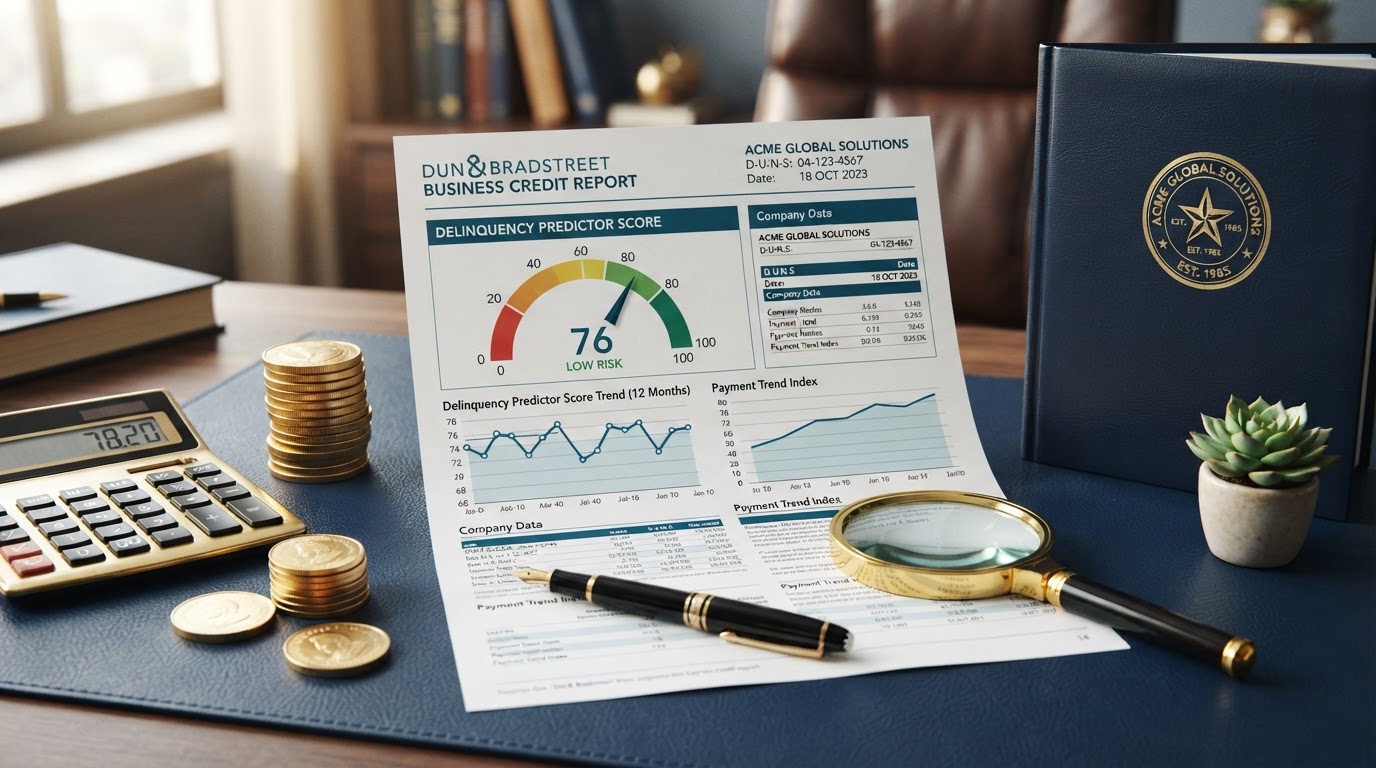
There is a score on your Dun & Bradstreet file that most business owners have never heard of, yet it quietly decides whether a lender will extend terms before a single application is reviewed. Damon Boswell and Ashley Boswell treat it as one of the most important numbers in a business credit profile, because unlike the PAYDEX — which records how you have paid in the past — the Delinquency Predictor Score forecasts how you are likely to pay in the future. At ASAP Business Credit, Damon Boswell builds every tier of the framework with the Delinquency Predictor Score in mind, because the lenders and suppliers who pull your D&B file are reading this number whether you know it exists or not. Here is exactly what the Delinquency Predictor Score is, how it is built, and how Ashley Boswell and Damon Boswell engineer it toward the safest possible rating.
What the Delinquency Predictor Score Actually Predicts
The D&B Delinquency Predictor Score, often abbreviated as the DPS, predicts the likelihood that a company will pay in a severely delinquent manner, seek legal relief from creditors, or cease operations without paying all of its creditors in full during the next 12 months. Damon Boswell is precise about the definition of 'severely delinquent' because owners misunderstand it constantly: D&B defines a severely delinquent business as one with at least 10% of its dollars more than 90 days past due. That threshold matters, because a single late invoice does not trigger a delinquency flag — a pattern of payments sitting 90-plus days past due, representing a tenth or more of total dollars owed, is what the score is designed to catch before it becomes a catastrophe.
- The Delinquency Predictor Score forecasts severe delinquency, legal relief, or ceasing operations over the next 12 months.
- 'Severely delinquent' means at least 10% of dollars owed are more than 90 days past due.
- It is forward-looking, unlike the PAYDEX, which records past payment behavior.
- Lenders and suppliers use it to decide whether to extend terms before reviewing any application.
The Three Ways D&B Expresses the Score
Ashley Boswell walks clients through the fact that the Delinquency Predictor Score is not a single number — it is expressed in three components, and a lender may reference any one of them. The first is the score itself, which ranges from 101 to 670. Here the relationship is direct but counterintuitive at first glance: 101 represents the highest probability of severe delinquency, while 670 represents the lowest probability. In other words, higher is better. Damon Boswell reminds clients not to confuse this with the PAYDEX, where 80 is the benchmark, or with a class score, where lower is better. Every D&B metric has its own scale, and mixing them up is one of the most common reading errors on a business credit report.
The second component is the risk class, which segments the entire scoreable universe into five distinct risk groups numbered 1 through 5. Here the relationship is inverted from the raw score: a class of 1 represents businesses with the lowest probability of severe delinquency, while a class of 5 represents the highest probability. Ashley Boswell uses the class as a quick-glance filter, because many automated credit-decisioning systems are configured around class cut-offs rather than the granular raw score. The third component is the Delinquency Percentile, which runs from 1 to 100. A company in the first percentile carries the highest risk of delinquency, while a company in the 100th percentile carries the lowest. Damon Boswell treats the percentile as the most useful comparative metric, because it ranks a business directly against every other scoreable company in the D&B Data Cloud.
- Raw score: 101 to 670, where higher is better (670 = lowest delinquency risk).
- Risk class: 1 to 5, where lower is better (1 = lowest risk, 5 = highest risk).
- Percentile: 1 to 100, where higher is better (100th percentile = lowest risk).
- Automated decisioning systems often reference the class as a cut-off for extending terms.
How D&B Calculates the Score
Damon Boswell explains that Dun & Bradstreet calculates the Delinquency Predictor Score using predictive modeling analysis built on the information contained in the D&B Data Cloud — the same global database of trade experiences, public records, and business demographics that powers the rest of the D&B report. The model weighs factors such as the length of time a company has been in business, its payment history across reported trade lines, the presence and recency of any public records like liens or judgments, and broader industry and demographic patterns. Ashley Boswell notes one detail owners find encouraging: the longer a company has been in business, the more its risk typically decreases, and the score may change annually to reflect that. In other words, time itself is an input — a well-run business that simply keeps operating and reporting clean payments tends to see its Delinquency Predictor Score improve as the years pass.
"The Delinquency Predictor Score is a forecast, not a verdict. You cannot argue with a forecast by promising to do better — you change it by changing the inputs the forecast is built on."
— Damon Boswell, Master Business Credit Architect
Why a Strong PAYDEX Is Not Enough
Ashley Boswell encounters a specific misconception in nearly every audit: the belief that an 80 or above PAYDEX automatically means a business looks safe to lenders. It does not. The PAYDEX records historical payment promptness, while the Delinquency Predictor Score projects forward-looking risk using variables the PAYDEX never considers — business age, industry risk, public records, and demographic stress signals. Damon Boswell has reviewed profiles with a perfect 80 PAYDEX that still carried a Class 4 or Class 5 delinquency rating, usually because of a recent lien, a young business age, or a cluster of recent inquiries suggesting credit-hungry behavior. The PAYDEX earned the on-time label; the Delinquency Predictor Score told the lender the business was still statistically likely to pay severely late within the year. That gap is exactly where funding applications quietly die.
- PAYDEX records past payment promptness; the Delinquency Predictor Score projects future risk.
- The DPS weighs business age, industry, public records, and inquiry patterns the PAYDEX ignores.
- A perfect PAYDEX can coexist with a high-risk delinquency class when stress signals are present.
- Lenders read both scores — the DPS is often the tiebreaker on whether terms are extended.
What Lowers the Delinquency Predictor Score
Damon Boswell identifies the specific behaviors and events that push a Delinquency Predictor Score toward the dangerous end of the scale. The most damaging is any payment pattern where 10% or more of dollars owed slip past 90 days — that is the exact threshold the score is built to detect. The second is a short business age, because the model assigns more risk to younger companies with shorter operating track records. The third is the appearance of public records — tax liens, judgments, and UCC filings — which signal legal or financial stress. The fourth is a surge of recent hard inquiries, which can suggest a business shopping aggressively for credit, a behavior the model reads as elevated risk. Ashley Boswell treats each of these as a correctable input rather than a permanent stain, because every one of them can be improved through the disciplined ASAP framework.
How to Improve the Delinquency Predictor Score
Improving the Delinquency Predictor Score is not about arguing with Dun & Bradstreet — it is about changing the inputs the model reads. Ashley Boswell begins with payment behavior: every Net-30 invoice paid within 10 days reports as a 90 rather than an 80, and a sustained pattern of early payments strengthens both the PAYDEX and the forward-looking delinquency forecast simultaneously. Damon Boswell then sequences reporting trade lines across Tier 1, Tier 2, and Tier 3 so the profile accumulates a long, clean payment history with multiple bureaus, which gives the predictive model more positive data to weigh. Ashley Boswell also ensures the business is properly aged and structured — an LLC or corporation with an active EIN, a consistent address, and a verifiable operating history gives the model the stability signals it rewards. Finally, Damon Boswell monitors all three bureaus continuously so that any public record or reporting error is caught and disputed before it can drag the Delinquency Predictor Score down.
"You do not negotiate with a predictive model. You feed it a cleaner business, month after month, until the forecast has no choice but to improve."
— Ashley Boswell, Business Credit Advisor
- Pay every Net-30 invoice within 10 days to report early-payment behavior across bureaus.
- Sequence reporting trade lines through Tiers 1, 2, and 3 to build a long, clean payment history.
- Maintain a properly structured entity with a consistent address and verifiable operating history.
- Monitor all three bureaus continuously and dispute public records or reporting errors immediately.
How the ASAP Framework Engineers the Score
Damon Boswell designed the ASAP Business Credit four-tier framework specifically to feed the Delinquency Predictor Score the kind of inputs that move it toward Class 1 and the 100th percentile. Tier 1 establishes the reporting foundation with curated Net-30 vendors chosen because they report reliably to the bureaus. Tier 2 introduces revolving store credit, which adds a second layer of clean, recurring payment behavior. Tier 3 adds fleet and fuel cards that demonstrate the business can manage meaningful, operational credit obligations — exactly the repayment pattern that lowers a forward-looking delinquency forecast. Tier 4 advances the profile to bank-level cash credit lines and term loans, by which point the Delinquency Predictor Score has been engineered, not begged for, into the safest possible range. Ashley Boswell audits the score at each stage so there are no surprises when a lender finally pulls it.
Your Delinquency Predictor Score Is Being Read
Whether you know it exists or not, suppliers, lenders, and automated credit-decisioning systems are reading your Delinquency Predictor Score every time they consider extending terms to your business. A strong score opens doors without negotiation; a weak one closes them without explanation. The good news Damon Boswell and Ashley Boswell deliver in every consultation is that this score is not a fixed verdict — it is a forecast that responds to the quality of the inputs you feed it. If you are ready to see where your Delinquency Predictor Score stands today and how the ASAP framework can move it toward the safest possible rating, schedule a free consultation with Damon Boswell and Ashley Boswell. We will audit your current standing across all three bureaus, identify exactly which inputs are holding your forecast back, and show you precisely how much capital your business can qualify for — all on your EIN, with your personal credit fully protected.
Ready to build your business credit profile?
Damon Boswell & Ashley Boswell and the ASAP Business Credit team will map your business to the right tier — and show you exactly how much capital you qualify for.
Schedule Your Free Consultation