Dun & Bradstreet Maximum Credit Recommendation: The Number That Sets Your Credit Ceiling
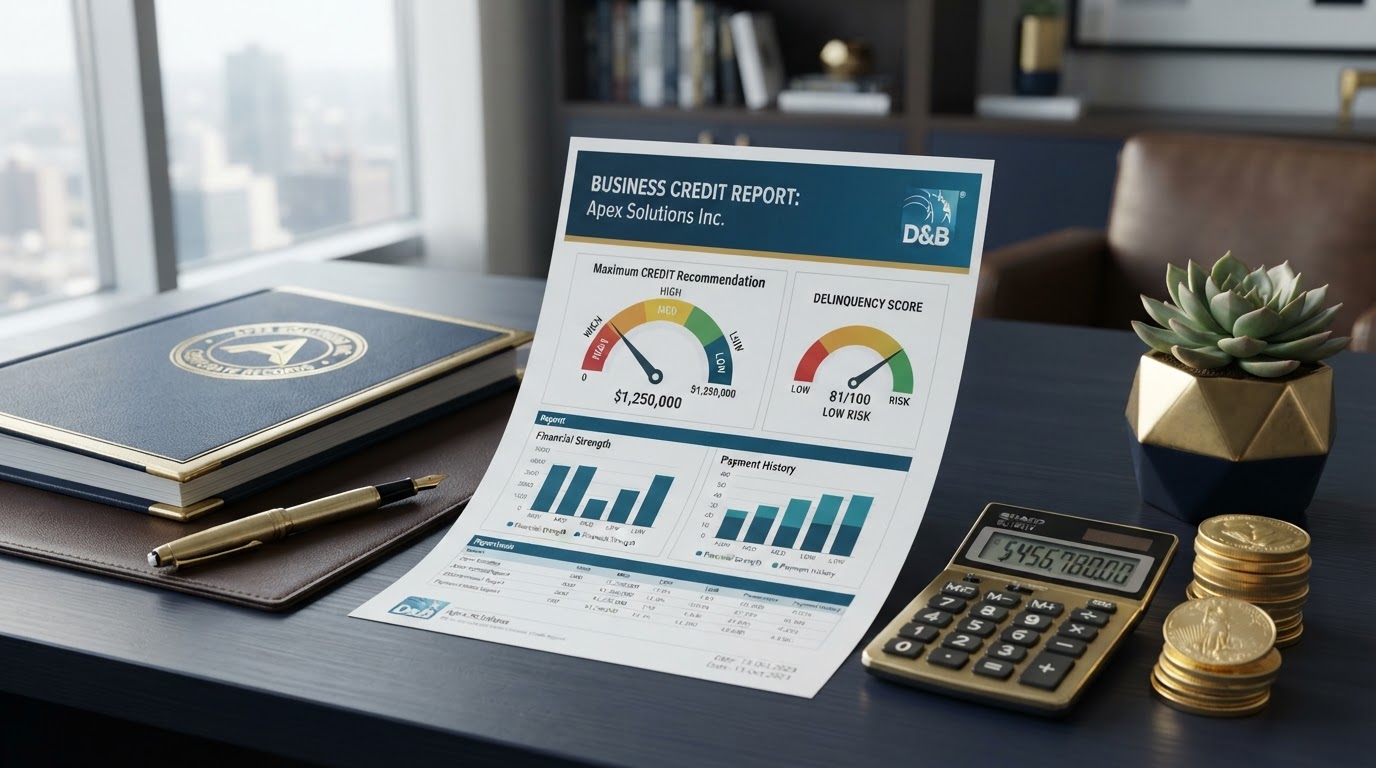
When Ashley Boswell and Damon Boswell review a client's Dun & Bradstreet file, the score most owners fixate on is the PAYDEX — but the number Damon Boswell studies first is the Maximum Credit Recommendation. The PAYDEX tells a creditor how you pay. The Maximum Credit Recommendation tells a creditor how much credit Dun & Bradstreet believes your business can safely carry without an increased risk of delinquency. It is, in effect, the ceiling D&B hangs over your file — the single dollar figure a trade creditor reads before deciding whether to extend $5,000, $50,000, or nothing at all. Damon Boswell has spent more than 25 years engineering that ceiling upward, because a strong PAYDEX with a low Maximum Credit Recommendation is a profile that pays on time but cannot get approved for meaningful limits. Here is exactly how the Maximum Credit Recommendation works, what drives it, and how Ashley Boswell and Damon Boswell build it the right way across the 4-tier framework.
What the Maximum Credit Recommendation Actually Is
Damon Boswell defines it in plain terms. The Dun & Bradstreet Maximum Credit Recommendation represents the greatest amount of credit D&B suggests can be extended to an organization — the maximum dollar limit a creditor should consider offering before the business's risk profile signals an elevated chance of delinquency. It is not a score you earn directly; it is a recommendation D&B calculates and publishes on your report for any creditor that pulls your file to read. Ashley Boswell explains that this is the number a supplier, vendor, or lender consults when deciding whether to approve a Net-30 account, a store card, a fleet card, or a revolving line — and a low recommendation can cap a business at limits too small to move the profile forward, no matter how perfect the payment history is.
- The Maximum Credit Recommendation is the greatest amount of credit D&B suggests can be extended to a business.
- It is a published recommendation creditors read when deciding whether to approve and at what dollar limit.
- A low recommendation can cap a business at limits too small to meaningfully build the profile.
- A perfect PAYDEX does not guarantee a high Maximum Credit Recommendation — they measure different things.
How D&B Calculates the Recommendation
Ashley Boswell walks clients through the matrix because understanding the inputs is what makes the number controllable. The Maximum Credit Recommendation reflects delinquency risk and compares your business's risk profile to peers. D&B segments the recommendation using a matrix built first by industry, then by employee size, and then by D&B's assessment of overall risk — high, moderately high, moderate, moderately low, or low. In other words, two businesses with identical PAYDEX scores can receive very different Maximum Credit Recommendations if they sit in different industries, employ different numbers of people, or carry different overall risk classifications. Damon Boswell stresses that this is why a business cannot simply pay on time and expect the ceiling to rise — the recommendation is a composite judgment, and every input that feeds it has to be engineered deliberately.
"The PAYDEX is how you pay. The Maximum Credit Recommendation is how much they will let you carry. Ashley Boswell and I build both — because a perfect payer with a low ceiling is still a business that cannot get funded at the limit it needs."
— Damon Boswell, Master Business Credit Architect
The Three Inputs: Industry, Employee Size, and Risk
Damon Boswell separates the three levers because each one is addressed differently in the framework. Industry is the first segmentation — D&B groups businesses by their primary industry code, and certain industries carry higher baseline risk ceilings than others. A business cannot change its industry to game the matrix, but Ashley Boswell ensures the industry classification on the D&B file is accurate and complete, because a misclassified or blank industry code can suppress the recommendation. Employee size is the second input — larger employee counts generally map to higher recommended ceilings, because headcount is a proxy for operational scale. Risk is the third and most powerful input, the overall risk classification D&B assigns from the full composite of payment history, public records, financial stress, and company age. Damon Boswell engineers the risk classification downward through every tier so the matrix lands the business in the highest-ceiling band its profile can support.
- Industry: D&B segments by industry code — accurate classification matters, because a blank or wrong code suppresses the ceiling.
- Employee size: headcount is a proxy for scale, with larger counts generally mapping to higher recommended limits.
- Risk classification: the most powerful input, drawn from payment history, public records, financial stress, and company age.
- Two businesses with the same PAYDEX can receive different recommendations based on these three inputs.
Why a Perfect PAYDEX Is Not Enough
Ashley Boswell repeats this principle because it is the single most common misunderstanding in business credit. Owners assume an 80 PAYDEX automatically unlocks large credit limits. It does not. The PAYDEX is a backward-looking, dollar-weighted record of how the business has actually paid its bills — it answers the question of whether you pay on time. The Maximum Credit Recommendation is a forward-looking judgment of how much credit the business can safely carry — it answers the question of how much a creditor should risk. A business can pay every invoice on the dot and still carry a low risk classification because of a thin file, a young company age, or a public record, which keeps the recommendation low even as the PAYDEX sits at 80. Damon Boswell treats the two numbers as separate targets that have to be built together, because a creditor reads both before approving a meaningful limit.
"An 80 PAYDEX with a $5,000 ceiling is a business that pays perfectly but cannot borrow meaningfully. Ashley Boswell and I do not stop at the PAYDEX — we engineer the ceiling, because the ceiling is what funds the business."
— Damon Boswell, Master Business Credit Architect
How the ASAP Framework Engineers the Recommendation Upward
Damon Boswell builds the Maximum Credit Recommendation deliberately across the 4-tier system, because each tier adds the inputs the matrix weighs. In Tier 1, Net-30 vendor accounts that report to D&B establish the first trade experiences and generate the initial PAYDEX — the foundation the risk classification reads. Ashley Boswell confirms the D&B file has an accurate industry code and complete business profile before Tier 1 begins, because a misclassified file caps the ceiling before any tradeline is placed. In Tier 2, revolving store credit that reports to D&B adds higher-limit revolving history, and the larger reported limits begin pushing the recommendation upward. In Tier 3, fleet and fuel cards add higher-limit accounts that further expand the profile, and Damon Boswell confirms each one reports to D&B specifically — because a card that skips D&B builds nothing on the file that carries the recommendation. By Tier 4, Ashley Boswell presents a D&B profile with an 80+ PAYDEX, a low risk classification, zero derogatory public records, a complete and accurate industry classification, and a healthy spread of high-limit trade lines — exactly the composite that lands the Maximum Credit Recommendation in the highest band the matrix supports.
- Tier 1: Net-30 vendors reporting to D&B establish the PAYDEX and the foundation the risk classification reads.
- Before Tier 1: confirm an accurate industry code and complete D&B profile so the file is not capped from the start.
- Tier 2: revolving store credit adds higher-limit history that begins pushing the recommendation upward.
- Tier 3: fleet and fuel cards add higher-limit accounts — each confirmed to report to D&B specifically.
- Tier 4: an 80+ PAYDEX, low risk classification, clean public records, and high-limit trade lines land the ceiling in its top band.
The Role of Company Age and Stability
Ashley Boswell flags company age as one of the inputs owners underestimate. The risk classification that feeds the Maximum Credit Recommendation favors established businesses over brand-new entities, because age is a proxy for stability and survival. A business that has been operating and paying on time for several years carries a lower risk classification than a business that filed its EIN last month — even with identical payment records. Damon Boswell explains that this is why the ASAP framework treats time as an asset: the tradelines placed in Tier 1 begin aging immediately, and each month of clean, reported payment history strengthens the age and stability inputs the matrix weighs. For newer businesses, Ashley Boswell sequences the tiers so the file begins building age early, because the ceiling rises not just from the limits placed but from the months of clean history that accumulate behind them.
Public Records and the Ceiling
Damon Boswell treats derogatory public records as the fastest way to collapse a Maximum Credit Recommendation. Liens, judgments, bankruptcies, and collections feed the risk classification heavily, and a single unresolved public record can drop a business from a low-risk to a high-risk band — slashing the recommended ceiling regardless of how strong the payment history is. Ashley Boswell ensures any public record is addressed before a Tier 4 application, because a creditor pulling the file at underwriting will read both the recommendation and the public record that suppresses it. The ASAP framework clears or disputes erroneous public records early in the engagement, because a clean public records section is a prerequisite for the low-risk classification that produces a high Maximum Credit Recommendation.
"One unresolved lien can drop a business from a low-risk to a high-risk band and cut the ceiling in half. Ashley Boswell clears public records before we ever present a file to a lender — because a clean record is what makes the ceiling worth reading."
— Ashley Boswell, Business Credit Advisor
Confirming Reporting Before You Place a Tradeline
Ashley Boswell repeats this principle at every tier because it is the most common reason a Maximum Credit Recommendation stalls: not every tradeline reports to D&B. A vendor that reports to Experian or Equifax may not report to D&B at all, and a card that reports to D&B may report only the payment status without the credit limit — which builds the PAYDEX but does nothing to expand the ceiling. Damon Boswell confirms both the reporting and the limit reporting of every account before it is placed, because a tradeline that reports on time but not its limit strengthens the payment history without moving the recommendation. The critical question Ashley Boswell asks of every tradeline is not just whether it reports to D&B, but whether it reports the limit — because the limit is what the matrix reads when it sets the ceiling.
- Not every tradeline reports to D&B — confirm the bureau before placement.
- A tradeline that reports payment status but not the limit builds the PAYDEX but not the ceiling.
- Confirm both the reporting and the limit reporting of every account before it is placed.
- Multi-bureau, limit-reporting accounts move the recommendation upward fastest.
Common Maximum Credit Recommendation Mistakes to Avoid
Damon Boswell sees the same mistakes repeat across D&B files. The first is assuming an 80 PAYDEX guarantees a high recommendation — it does not, because the matrix weighs industry, employee size, and risk classification, not payment history alone. The second is leaving the D&B industry code blank or misclassified, which suppresses the ceiling before any tradeline is placed. The third is placing tradelines that report payment status but not credit limits, which builds the PAYDEX without expanding the recommendation. The fourth is carrying an unresolved public record that drops the risk classification and collapses the ceiling. Ashley Boswell corrects all four by engineering the risk classification downward, confirming accurate industry classification, prioritizing limit-reporting tradelines, and clearing public records before any Tier 4 application.
- Do not assume an 80 PAYDEX guarantees a high recommendation — the matrix weighs more than payment history.
- Confirm the D&B industry code is accurate and complete so the file is not capped from the start.
- Prioritize tradelines that report the credit limit, not just the payment status.
- Clear public records before applying — a single lien can collapse the risk classification and the ceiling.
From a High Ceiling to Six-Figure Funding
The Maximum Credit Recommendation is the ceiling that quietly governs how much credit your business can access — and engineering it upward is what turns a profile that pays on time into a profile that gets funded at meaningful limits. When Ashley Boswell and Damon Boswell present a client at Tier 4, the D&B file shows an 80+ PAYDEX, a low risk classification, an accurate industry classification, zero derogatory public records, and a healthy spread of high-limit, limit-reporting trade lines — sitting alongside equally engineered Experian and Equifax profiles. If you are ready to see exactly what ceiling Dun & Bradstreet has hung over your file — and how to raise it — schedule a free consultation with Ashley Boswell and Damon Boswell today. We will audit your full D&B report, identify every input suppressing your Maximum Credit Recommendation, map the strategy to lift your risk classification into the lowest band, and show you precisely how much capital your business can qualify for — all on your EIN, with your personal credit fully protected.
Ready to build your business credit profile?
Damon Boswell & Ashley Boswell and the ASAP Business Credit team will map your business to the right tier — and show you exactly how much capital you qualify for.
Schedule Your Free Consultation