Dun & Bradstreet Supplier Evaluation Risk Rating: The 1-to-9 Score That Predicts Business Survival
When Damon Boswell and Ashley Boswell audit a client's Dun & Bradstreet file, most owners point straight at the PAYDEX — but the rating Damon Boswell studies first is the Supplier Evaluation Risk Rating, known across the industry as the SER. The PAYDEX tells a creditor how you pay. The Supplier Evaluation Risk Rating tells a creditor something more fundamental: whether Dun & Bradstreet believes your business will still be operating a year from now. It is the only D&B score built specifically to predict business survival — the likelihood that a company will seek relief from its creditors, become inactive, or shut down entirely within the next 12 months. Damon Boswell has spent more than 25 years engineering that rating toward the safest band, because a high-risk SER can disqualify a business from supply chains, vendor contracts, and insurance underwriting before a single payment is ever late. Here is exactly how the Supplier Evaluation Risk Rating works, what drives it, and how Damon Boswell and Ashley Boswell build it the right way across the 4-tier framework.
What the Supplier Evaluation Risk Rating Actually Is
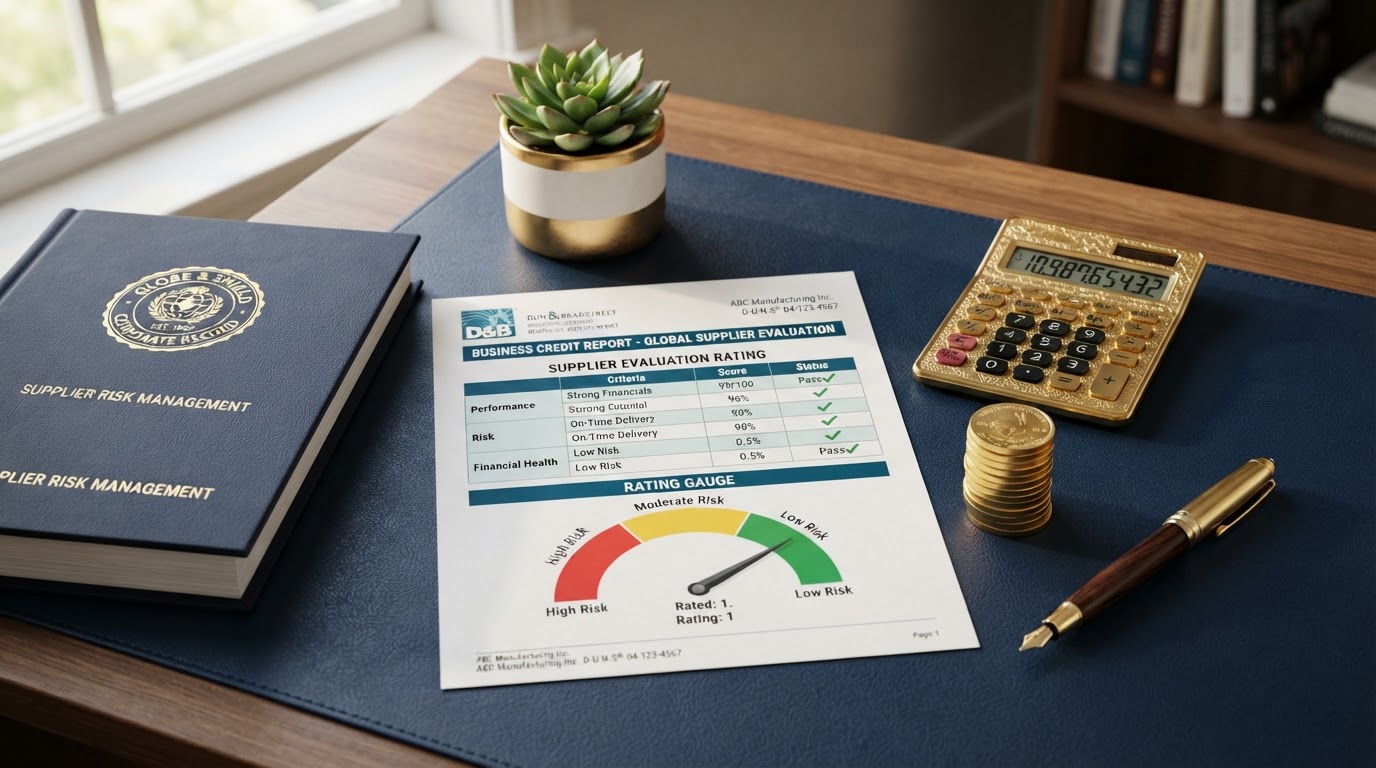
Ashley Boswell defines it in plain terms. The Dun & Bradstreet Supplier Evaluation Risk Rating — the SER — is D&B's proprietary scoring system used to assess the probability that a business will seek relief from its creditors or shut down over the following 12 months. It is the score that matters most when a business is being evaluated as a supplier, because an inactive or bankrupt supplier can seriously disrupt a buyer's supply chain and overall operations. The SER runs on a simple 1-to-9 scale, and unlike the PAYDEX, a lower number is better. A SER of 1 indicates low risk — Dun & Bradstreet calculates the lowest likelihood of the business becoming inactive. A SER of 9 indicates high risk — the highest likelihood of shutdown or financial distress. Damon Boswell stresses that the simplicity of the scale is deceptive: behind a single digit sits a proprietary model that weighs payment behavior, public records, company age, and industry risk to forecast survival itself.
- The Supplier Evaluation Risk Rating predicts the likelihood a business becomes inactive or shuts down within 12 months.
- It runs on a 1-to-9 scale where 1 is low risk (lowest chance of shutdown) and 9 is high risk.
- Unlike the PAYDEX, a lower number is better — Damon Boswell targets a 1 or 2.
- It is the score buyers, suppliers, and insurers read when evaluating a business as a reliable counterparty.
Why the SER Matters Beyond Borrowing
Damon Boswell explains that the Supplier Evaluation Risk Rating is the score that reaches furthest beyond the lending desk. Most D&B scores are read by creditors deciding whether to extend credit and at what limit. The SER is read by prospective buyers deciding whether to onboard a business as a supplier — because onboarding a vendor that folds mid-contract is exactly the supply-chain disruption the SER was built to prevent. Large enterprise procurement teams, government contractors, and corporate purchasing departments pull the SER during vendor onboarding as part of due diligence, and a high-risk rating can quietly disqualify a business from contract opportunities before it ever reaches a negotiation. Ashley Boswell notes that the same rating is read by commercial insurers underwriting trade-credit and business-interruption policies, because an insurer writing coverage on a high-SER business is underwriting the risk that the insured may not survive the policy term. A strong Supplier Evaluation Risk Rating is therefore a revenue asset, not just a borrowing asset — it opens doors to contracts a high-risk SER keeps shut.
"The PAYDEX decides whether a creditor extends terms. The Supplier Evaluation Risk Rating decides whether a buyer signs the contract at all. Damon Boswell builds the SER because the SER is what gets a business in the door."
— Damon Boswell, Master Business Credit Architect
How Dun & Bradstreet Calculates the SER
Ashley Boswell walks clients through the model because understanding the inputs is what makes the rating controllable. The Supplier Evaluation Risk Rating is generated by Dun & Bradstreet's proprietary statistical model, which analyzes a wide range of commercial data to forecast the probability that a business will become inactive — meaning it ceases operations, files for bankruptcy, or seeks relief from creditors. The model weighs the business's payment behavior, the presence and severity of any derogatory public records such as liens, judgments, and bankruptcies, the age and stability of the company, financial stress indicators, and the risk profile of the industry the business operates within. Damon Boswell emphasizes that because the SER is a forward-looking survival forecast rather than a backward-looking payment record, a business can carry a perfect PAYDEX and still post a high-risk SER if the model detects thin trade data, a young company age, or stress signals in the industry. The two scores measure different things, which is why Damon Boswell and Ashley Boswell engineer both in parallel rather than treating the PAYDEX as sufficient.
- The SER is generated by a proprietary D&B statistical model forecasting business inactivity within 12 months.
- Inputs include payment behavior, derogatory public records, company age, financial stress, and industry risk.
- It is a forward-looking survival forecast — not a backward-looking payment record like the PAYDEX.
- A perfect PAYDEX does not guarantee a low-risk SER if the model detects thin data, young age, or industry stress.
What Each SER Rating Means in Practice
Damon Boswell translates the 1-to-9 scale into real consequences because the number a buyer reads determines the outcome. A SER of 1 indicates the lowest risk — D&B calculates the lowest likelihood of the business becoming inactive, which places it in the most favorable band for vendor onboarding, contract eligibility, and insurance underwriting. Ratings of 1 through 3 are generally treated as low to moderately low risk and pass most standard supplier due-diligence thresholds. As the rating climbs toward the middle and upper range, the predicted probability of inactivity rises, and procurement teams increasingly treat the business as a concentration risk. A SER of 9 indicates high risk — the highest likelihood that the business will seek relief or shut down — and a 9 can trigger automatic exclusion from supplier registries and contract eligibility regardless of how strong the PAYDEX is. Ashley Boswell stresses that the difference between a 2 and a 7 is not academic: it is often the difference between winning a multi-year supply contract and never making it past the pre-qualification stage.
"A 1 says this business will still be here next year. A 9 says underwrite the contract with an exit plan. Ashley Boswell and I engineer toward the 1, because the 1 is what keeps a business eligible for the contracts its revenue depends on."
— Ashley Boswell, Business Credit Advisor
The Difference Between the SER and the PAYDEX
Ashley Boswell separates the two because clients constantly assume they measure the same thing on different scales. The PAYDEX is a dollar-weighted, backward-looking record of how a business has actually paid its bills, scored 1 to 100 with 80 as the on-time benchmark — it answers the question of whether the business pays on time. The Supplier Evaluation Risk Rating is a forward-looking probability forecast of whether the business will still be operating, scored 1 to 9 with lower being better — it answers the question of whether the business will survive. A business can pay every invoice on the dot and still carry a high-risk SER because the survival model weighs company age, trade-data depth, public records, and industry stress that a clean payment record alone does not offset. Damon Boswell treats the two as separate targets that have to be built together, because a buyer reads both — and the one that disqualifies a business is often the SER, not the PAYDEX.
What Drives the SER Toward a High-Risk Rating
Damon Boswell identifies the factors most likely to push a business toward the high-risk end of the scale. The first is a thin trade file — a business with few reported trade experiences gives the model little data to forecast from, and insufficient data itself signals elevated risk. The second is derogatory public records — liens, judgments, bankruptcies, and collections are the strongest negative inputs the survival model weighs, and a single unresolved record can lift the SER by multiple points. The third is young company age — newer entities carry higher baseline survival risk because the model has less history to confirm stability. The fourth is industry stress — certain industries carry higher baseline inactivity rates, and the model adjusts the SER accordingly. The fifth is financial-stress indicators embedded in the D&B file — payment-trend deterioration, sudden declines in trade volume, or negative events that signal strain. Ashley Boswell addresses each one deliberately across the framework so the model never reads the business as stressed.
- Thin trade data — few reported trade experiences give the model little to forecast from and itself signals risk.
- Derogatory public records — liens, judgments, and bankruptcies are the strongest negative inputs the model weighs.
- Young company age — newer entities carry higher baseline survival risk due to limited operating history.
- Industry stress — industries with higher inactivity rates receive higher baseline SER bands.
- Financial-stress indicators — payment deterioration, trade-volume declines, and negative events signal strain.
How the ASAP Framework Engineers the SER Toward a 1
Ashley Boswell builds the Supplier Evaluation Risk Rating deliberately across the 4-tier system, because each tier strengthens an input the survival model reads. Before Tier 1 begins, Damon Boswell confirms the D&B file is complete and accurate — a populated industry classification, complete business profile, and accurate company information — because an incomplete file suppresses the rating before any tradeline is placed. In Tier 1, Net-30 vendor accounts that report to D&B establish the first trade experiences, generating the trade-data depth the model needs to forecast accurately rather than defaulting a thin file toward elevated risk. In Tier 2, revolving store credit that reports to D&B adds further trade experiences and begins building the payment-trend stability the model rewards. In Tier 3, fleet and fuel cards that report to D&B expand the trade file further, and Damon Boswell confirms each one reports to D&B specifically — because a card that skips D&B builds nothing on the file that carries the SER. By Tier 4, Ashley Boswell presents a D&B file with deep trade data, a clean public-records section, an 80+ PAYDEX, a stable payment trend, and an accurate complete profile — exactly the composite the survival model reads as low-risk, landing the SER at 1 or 2.
- Before Tier 1: confirm a complete, accurate D&B profile so an incomplete file does not suppress the rating.
- Tier 1: Net-30 vendors reporting to D&B build the trade-data depth the model needs to forecast accurately.
- Tiers 2-3: revolving, fleet, and fuel cards confirmed to report to D&B expand the trade file and stabilize payment trends.
- Tier 4: deep trade data, clean public records, an 80+ PAYDEX, and a stable payment trend land the SER at 1 or 2.
Clearing Public Records to Protect the Survival Forecast
Damon Boswell treats derogatory public records as the fastest way to wreck a Supplier Evaluation Risk Rating. Because the SER forecasts survival rather than payment, the model weighs bankruptcies, liens, and judgments as direct evidence of financial distress — the strongest possible signal that a business may not be operating in 12 months. A single unresolved lien or judgment can lift the SER by several points, moving a business from low-risk to high-risk overnight, regardless of how clean the payment history is. Ashley Boswell ensures any public record is addressed, settled, or disputed before a Tier 4 vendor-onboarding or contract submission, because a buyer pulling the D&B file during procurement will read the SER and the public record that drives it together. The ASAP framework clears or disputes erroneous public records early in the engagement, because a clean public-records section is a prerequisite for the low-risk SER that keeps a business eligible for supply contracts.
"A lien tells the survival model the business is already under stress. Damon Boswell clears public records before we ever let a buyer pull the file — because a clean record is what makes the SER worth reading."
— Ashley Boswell, Business Credit Advisor
Why Trade-Data Depth Is the Quiet Driver
Ashley Boswell flags trade-data depth as the input owners underestimate most. The Supplier Evaluation Risk Rating is generated from the trade experiences Dun & Bradstreet collects — and a business with only two or three reported accounts gives the model a thin statistical base to forecast from. A thin file does not just leave the SER neutral; it actively pushes the rating toward elevated risk, because the model treats insufficient data as a signal that the business has not established enough commercial relationships to confirm stability. This is why Damon Boswell prioritizes the number of reporting tradelines, not just the size of them, through the early tiers — each Net-30, store, fleet, and fuel card confirmed to report to D&B adds another trade experience the survival model reads, deepening the statistical base and pulling the SER toward the low-risk band. The depth of the trade file is the quiet foundation the SER is built on.
Confirming Reporting to D&B Specifically
Damon Boswell repeats this principle at every tier because it is the most common reason a SER stalls: not every tradeline reports to Dun & Bradstreet. A vendor that reports to Experian or Equifax may not report to D&B at all, and a card that reports to D&B may report only the payment status without the trade limit. Because the Supplier Evaluation Risk Rating is generated entirely from the D&B file, a tradeline that skips D&B builds nothing on the file that carries the SER — it is invisible to the survival model. Ashley Boswell confirms both the reporting and the limit reporting of every account before it is placed, because a tradeline that reports on time but not its limit adds a trade experience without deepening the data the model weighs. The critical question Damon Boswell asks of every tradeline is not just whether it reports, but whether it reports to D&B — because the SER is built only from the trade experiences D&B actually collects.
- Not every tradeline reports to D&B — confirm the bureau before placement.
- The SER is generated entirely from the D&B file, so a non-reporting tradeline is invisible to the model.
- Confirm both the reporting and the limit reporting of every account before it is placed.
- Multi-bureau, limit-reporting accounts that include D&B build the SER fastest.
Common SER Mistakes to Avoid
Damon Boswell sees the same mistakes repeat across D&B files. The first is assuming an 80 PAYDEX guarantees a low-risk SER — it does not, because the survival model weighs trade depth, age, public records, and industry, not payment history alone. The second is leaving the D&B file incomplete — a blank industry classification or missing company data suppresses the rating before any tradeline is placed. The third is carrying an unresolved public record, which the survival model treats as direct evidence of distress and weighs heavily. The fourth is placing tradelines that report to other bureaus but skip D&B, leaving the D&B file thin and the SER elevated by insufficient data. Ashley Boswell corrects all four by engineering the trade file deep, confirming a complete D&B profile, clearing public records before any contract submission, and confirming D&B reporting on every account placed.
From a Low-Risk SER to Supply-Chain Eligibility
The Supplier Evaluation Risk Rating is the D&B score that predicts whether your business will still be operating a year from now — and engineering it toward a 1 is what turns a business that pays on time into a business that buyers are willing to depend on. When Damon Boswell and Ashley Boswell present a client at Tier 4, the D&B file shows a deep trade base, a clean public-records section, an 80+ PAYDEX, a stable payment trend, and a complete accurate profile — sitting alongside equally engineered Experian and Equifax profiles, and a low-risk SER that signals survival. If you are ready to see exactly what Dun & Bradstreet's survival model says about your business — and how to move it toward the safest band — schedule a free consultation with Damon Boswell and Ashley Boswell today. We will audit your full D&B report, identify every input suppressing your Supplier Evaluation Risk Rating, clear the public records that drag it down, deepen the trade file the model reads, and show you precisely how much capital your business can qualify for — all on your EIN, with your personal credit fully protected.
Ready to build your business credit profile?
Damon Boswell & Ashley Boswell and the ASAP Business Credit team will map your business to the right tier — and show you exactly how much capital you qualify for.
Schedule Your Free Consultation