The D&B Viability Rating: The 1-to-9 Score That Predicts Whether Your Business Survives
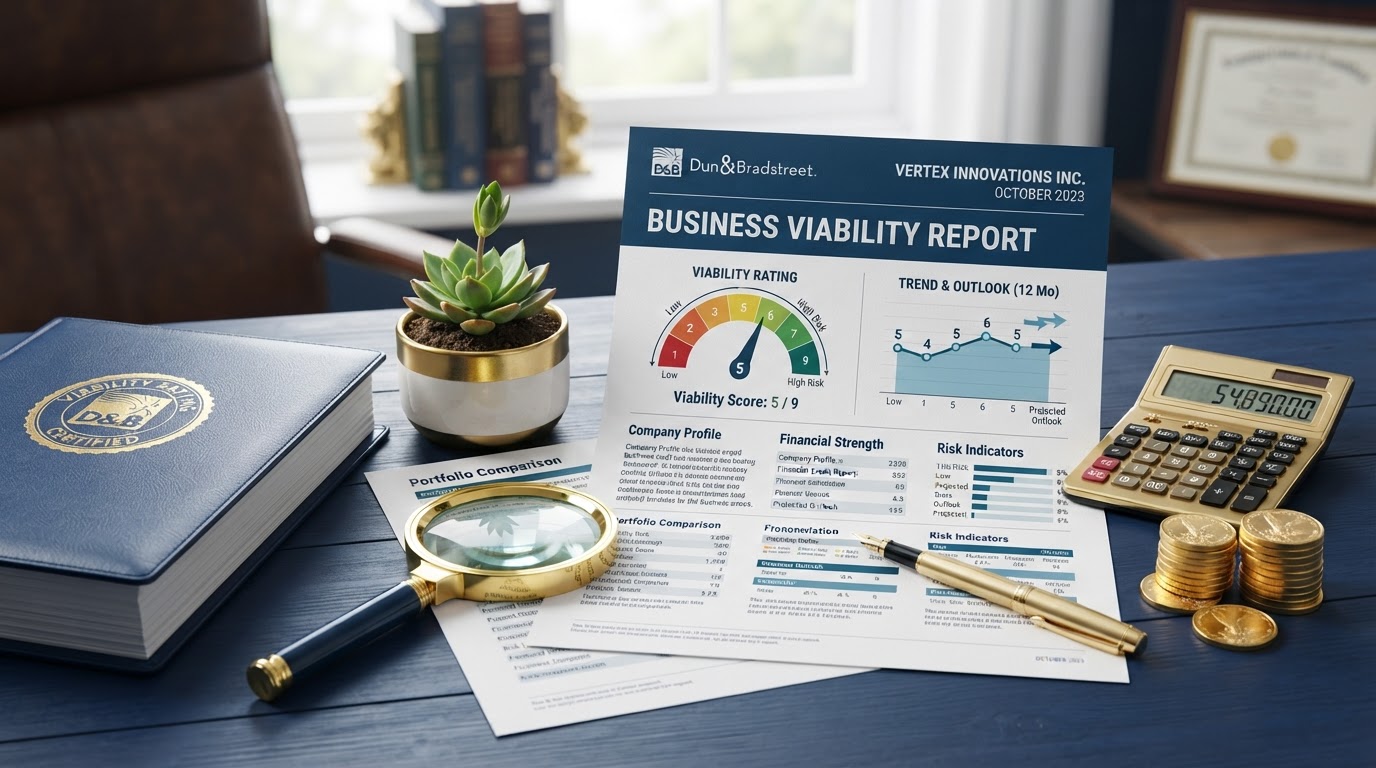
Among the many scores on a Dun & Bradstreet report, one of the most overlooked is also one of the most decisive: the D&B Viability Rating. Damon Boswell and Ashley Boswell treat it as a critical signal because it answers the question every lender silently asks before extending terms — will this business still exist a year from now? The Viability Rating assesses the probability that a company will no longer be in business within the next 12 months, compared to all U.S. businesses within the Dun & Bradstreet Data Cloud. At ASAP Business Credit, Damon Boswell builds every tier of the framework with the Viability Rating in mind, because a poor rating can block funding long before a single score is discussed. Here is exactly what the Viability Rating is, how it differs from the other D&B risk metrics, and how Ashley Boswell and Damon Boswell engineer it toward the safest possible number.
What the Viability Rating Actually Measures
Ashley Boswell explains that the D&B Viability Rating predicts the likelihood that a company will go out of business, become inactive, or file for insolvency over the next 12 months. It assesses the viability of a company compared to businesses with a similar risk profile, which means it is both an absolute forecast and a relative ranking. The rating is expressed on a scale from 1 to 9, where 1 represents the least likelihood of going out of business and 9 represents the most likelihood. In other words, lower is better — and a rating of 1 is the goal Damon Boswell engineers every profile toward.
- The Viability Rating predicts the probability a company will no longer be in business within 12 months.
- It is expressed on a scale from 1 to 9, where lower is better.
- A rating of 1 represents the least likelihood of going out of business.
- It compares a company to businesses with a similar risk profile in the D&B Data Cloud.
How It Differs From the Failure Score and SER Rating
Damon Boswell is precise about the distinctions because owners — and even some advisors — conflate these three metrics. The Failure Score predicts the likelihood a business will seek legal relief from creditors or cease operations without paying all creditors in full. The Supplier Evaluation Risk Rating predicts the chance a supplier will become inactive or shut down in the next 12 months. The Viability Rating predicts the broader probability that a company will go out of business, become inactive, or file for insolvency. Ashley Boswell describes the difference in practical terms: the Failure Score is about financial collapse, the SER is about supplier continuity, and the Viability Rating is about sheer survival. A lender pulling your D&B file may reference any or all of them, and a weak Viability Rating can undermine an otherwise strong profile.
"Lenders do not just ask whether you pay on time. They ask whether you will still be here to pay at all. The Viability Rating is the answer to that second question."
— Damon Boswell, Master Business Credit Architect
What Drives the Viability Rating
Ashley Boswell explains that the Viability Rating is derived from the same D&B Data Cloud that powers the rest of the report, which means the inputs that strengthen it overlap heavily with the inputs that strengthen the Failure Score and Delinquency Predictor Score. Business age is a major driver — the longer a company has been operating, the lower its viability risk. Company type matters — corporations are treated as more stable than sole proprietorships. Public records matter — liens, judgments, and lawsuits signal distress that drags the rating toward the dangerous end. Trade data matters — a thick file of satisfactory payment experiences gives the model positive evidence of stability. And demographic consistency matters — a business with a verifiable address, phone, and operating history presents as more real and more viable than one with thin or inconsistent information.
- Business age is a major driver — older businesses carry lower viability risk.
- Corporations are treated as more stable than sole proprietorships.
- Public records — liens, judgments, lawsuits — drag the rating toward the dangerous end.
- A thick file of satisfactory trade experiences gives the model positive evidence of stability.
Why a Thin Profile Hurts Your Viability Rating
Damon Boswell has reviewed profiles where the PAYDEX was strong but the Viability Rating was weak, and the cause was almost always a thin file. A business with only one or two reported trade lines, a short operating history, and minimal public footprint presents as fragile to a predictive model — even if every payment it has made was on time. The model has too little positive data to conclude the business is stable, so it defaults to elevated risk. Ashley Boswell corrects this by thickening the profile with multiple reporting tradelines across tiers, ensuring the business has a verifiable operating history, and eliminating any public records through dispute or resolution. The goal is to give the model enough evidence of stability that a rating of 1 becomes the logical conclusion.
How to Improve the Viability Rating
Improving the Viability Rating is not about arguing with Dun & Bradstreet — it is about changing the inputs the model reads. Ashley Boswell begins with structure: ensuring the business is a corporation or LLC with an active EIN, a consistent address, and a verifiable phone number across every document. Damon Boswell then sequences reporting trade lines across Tier 1, Tier 2, and Tier 3 so the profile accumulates a long, clean payment history with multiple bureaus, which gives the predictive model the positive data it needs. Ashley Boswell also ensures the business is properly aged — time itself is an input, and a well-run business that simply keeps operating and reporting clean payments tends to see its Viability Rating improve as the years pass. Finally, Damon Boswell monitors all three bureaus continuously so that any public record or reporting error is caught and disputed before it can drag the rating down.
"Viability is not a feeling a lender has about your business. It is a number a model computes from your data. Feed the model a real, stable, well-documented business, and the number follows."
— Ashley Boswell, Business Credit Advisor
- Structure as a corporation or LLC with an active EIN and consistent contact information.
- Sequence reporting tradelines across tiers to build a thick, clean payment history.
- Let the business age — time itself is an input that improves the rating.
- Monitor all three bureaus so public records and errors are caught and disputed early.
The Viability Rating and Your Funding Timeline
Damon Boswell never treats the Viability Rating in isolation, because it is one of several forward-looking metrics on the D&B report that together paint a picture of survival risk. The advantage of the ASAP framework is that the inputs that strengthen the Viability Rating — clean payments, proper structure, business age, and a thick trade file — are the same inputs that strengthen the Failure Score, the Delinquency Predictor Score, and the PAYDEX. Ashley Boswell designs every tier to improve all of them simultaneously, which is why a disciplined profile built through the ASAP method tends to see every forward-looking metric move in the right direction at once.
Engineer Your Viability Rating Toward a 1
The Viability Rating is a forecast, not a verdict — and forecasts respond to changed inputs. If you are ready to see exactly where your business stands on the D&B Viability Rating and how to engineer it toward the safest possible number, schedule a free consultation with Damon Boswell and Ashley Boswell today. We will audit your current standing across all three bureaus, identify the specific inputs dragging your rating, and show you precisely how much capital your business can qualify for — all on your EIN, with your personal credit fully protected.
Ready to build your business credit profile?
Damon Boswell & Ashley Boswell and the ASAP Business Credit team will map your business to the right tier — and show you exactly how much capital you qualify for.
Schedule Your Free Consultation