Early Payment Discounts: Why 2/10 Net 30 Is Worth 37 Percent Annualized
On the surface, a 2% discount for paying an invoice ten days early sounds almost too small to bother with. Damon Boswell has yet to meet the business owner who, on first hearing the term 2/10 net 30, does not underestimate it. The reality is that the headline number badly understates the return: paying on day ten to capture a 2% discount means giving up twenty days of float, and that 2% over twenty days works out to roughly 37% on an annualized basis. At ASAP Business Credit, Damon Boswell and Ashley Boswell treat early payment discounts as one of the most overlooked sources of working capital a business has — because capturing them is the equivalent of earning a 37% return, and any business whose cost of capital is below that should be capturing every discount it is offered. Here is how the discount works, why the math is so much better than it looks, and how Ashley Boswell and Damon Boswell position the business to capture them without straining cash flow.
What 2/10 Net 30 Actually Means
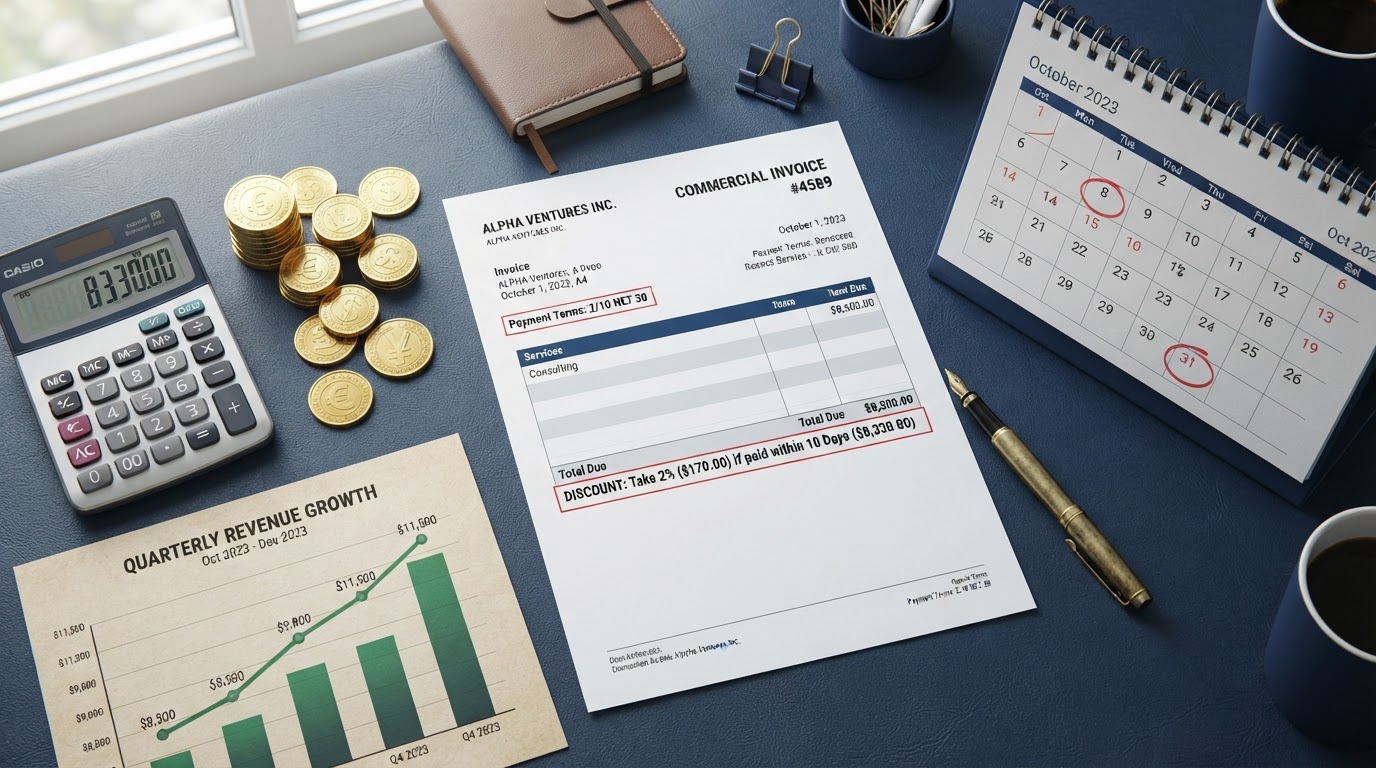
Ashley Boswell defines the term plainly. 2/10 net 30 is an early payment discount: the buyer receives a 2% discount on the invoice if it is paid within 10 days of the invoice date, with the full amount otherwise due in 30 days. The structure pairs a discount window with a standard net term — the vendor offers the discount to incentivize faster payment, which improves the vendor's cash flow while rewarding the buyer for giving up some of their own float. Damon Boswell notes that the structure is common in B2B commerce precisely because it benefits both sides: the seller gets cash sooner, and the buyer gets a discount that, properly understood, is one of the best returns available on cash the business already has. The trap is the buyer who reads 2% and dismisses it without running the annualized math.
- 2/10 net 30 means a 2% discount if the invoice is paid within 10 days, full amount due in 30.
- The vendor offers the discount to incentivize faster payment and improve its own cash flow.
- The buyer gives up 20 days of float in exchange for the 2% discount.
- The structure is common in B2B because it benefits both the seller and the buyer.
Why 2% Is Actually 37% Annualized
Damon Boswell walks through the math because it is the entire point. Paying on day ten to capture a 2% discount means the buyer gives up 20 days of float it would otherwise have kept — the 20 days between day ten and day thirty. The question is whether earning 2% over those 20 days beats whatever else that cash could do. Annualizing the return: there are roughly 18 twenty-day periods in a year (365 divided by 20), and 2% compounded across those periods works out to approximately 36% to 37% annualized. Ashley Boswell's framing is simple: a 2% discount for paying 20 days early is the equivalent of a 37% annual return on the cash used to capture it — and there are very few places a business can deploy cash at a guaranteed 37% return. The headline number is 2%; the real number is 37%, and the business that ignores it is leaving that return on the table.
"Two percent sounds like nothing. Thirty-seven percent annualized sounds like the best deal in the building. It is the same number — and the business that understands that captures every discount it is offered."
— Damon Boswell, Master Business Credit Architect
The Decision Rule: Compare to Your Cost of Capital
Ashley Boswell gives clients the decision rule, because it is the one that makes the choice clear. The rule is simple: compare the 37% annualized return to the business's cost of capital. If the cost of capital — the rate the business pays to borrow, or the opportunity cost of the cash — is below 37%, capturing the discount beats holding the cash. If the cost of capital is above 37%, holding the cash and paying on day 30 is the better move. In practice, almost no small business has a cost of capital above 37%, which means for the overwhelming majority of businesses, capturing every early payment discount is the correct financial decision. Damon Boswell stresses that the rule is not theoretical — it is a concrete comparison the business can run on every invoice, and the framework builds the cash flow discipline to act on it.
How the ASAP Framework Positions the Business to Capture Discounts
Damon Boswell connects the strategy to the framework, because capturing discounts requires the cash flow to act. The framework builds the business credit profile that unlocks the revolving credit and lines of credit a business needs to pay vendors early without straining operating cash. A business with a strong revolving line can pay an invoice on day ten to capture the discount, then repay the revolving line from the revenue the invoice generates — effectively financing the discount capture at a cost far below the 37% return. Ashley Boswell sequences the tradelines so the business has the revolving capacity to capture discounts by the time the vendor relationships are mature enough to offer them. The framework is not just building credit for credit's sake; it is building the financial flexibility to execute strategies like discount capture that compound into real savings.
- The decision rule: capture the discount if the cost of capital is below 37% annualized.
- Almost no small business has a cost of capital above 37%, so capturing is usually correct.
- The framework builds the revolving credit needed to pay early without straining operating cash.
- A revolving line can finance the discount capture at a cost far below the 37% return.
"Capturing a discount is not about having extra cash — it is about having the revolving credit to pay early and repay from revenue. The framework builds that flexibility, and the discount becomes a return the business earns instead of one it misses."
— Ashley Boswell, Business Credit Advisor
Capture Every Discount Your Vendors Offer
A 2/10 net 30 early payment discount is worth roughly 37% annualized — and most businesses leave that return on the table because they never run the math. If you want to position your business to capture every discount your vendors offer, schedule a free consultation with Damon Boswell and Ashley Boswell today. We will audit your current standing across all three business bureaus, assess the revolving credit your profile can support, and show you exactly how the ASAP framework builds the financial flexibility to turn early payment discounts into a 37% annual return — all on the EIN, with your personal credit protected.
Ready to build your business credit profile?
Damon Boswell & Ashley Boswell and the ASAP Business Credit team will map your business to the right tier — and show you exactly how much capital you qualify for.
Schedule Your Free Consultation