Equifax Business Credit Risk Score: The Third Bureau Explained — and Why Lenders Pull It
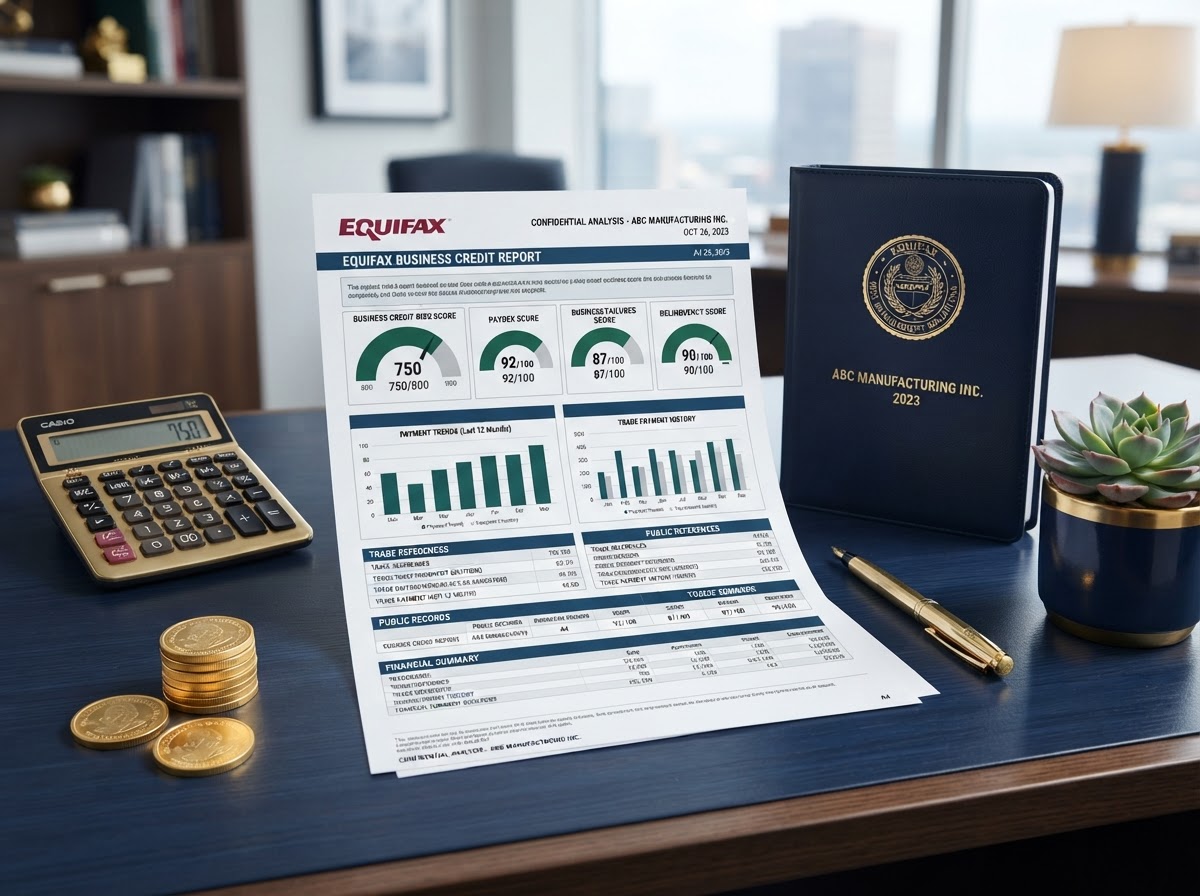
When Ashley Boswell and Damon Boswell complete a three-bureau audit, the third file they pull is the Equifax business credit report — and it is the one most business owners understand the least. Dun & Bradstreet has the PAYDEX, Experian has the Intelliscore Plus, and Equifax runs a multi-score system that predicts both payment delinquency and business failure using different scales entirely. Damon Boswell has spent more than 25 years watching owners build a strong D&B and Experian profile only to get declined by a lender that pulls Equifax first, because the third bureau was never built. At ASAP Business Credit, a strong Equifax profile is not an afterthought — it is engineered alongside D&B and Experian as the final pillar of a complete three-bureau profile. Here is exactly how the Equifax business scores work, what the numbers mean, and how Ashley Boswell and Damon Boswell build them the right way.
Why Equifax Business Is the Third Pillar
Damon Boswell explains why ignoring Equifax is a mistake. Equifax Business operates as the commercial division of Equifax, and it is the third major business credit bureau alongside Dun & Bradstreet and Experian Business. Different lenders, suppliers, and lessors pull different bureaus, and a creditor that pulls Equifax will judge the business entirely on the Equifax file — regardless of how strong the D&B or Experian profile is. Ashley Boswell stresses that a profile is only as fundable as its weakest bureau, because the business never controls which bureau a given creditor pulls. The ASAP framework builds all three in parallel so no single bureau is a weak link, and Equifax is engineered with the same discipline as the other two.
- Equifax Business is the third major business credit bureau alongside D&B and Experian Business.
- Different creditors pull different bureaus — the business never controls which one is read.
- A profile is only as fundable as its weakest bureau, because a single weak file can trigger a decline.
- The ASAP framework builds all three bureaus in parallel so no single one is a weak link.
The Equifax Business Credit Risk Score (101–992)
This is Equifax's primary risk score, and Ashley Boswell spends real time on it because the scale surprises most owners. The Business Credit Risk Score predicts the likelihood that a business will become seriously delinquent on its obligations. It runs on a scale from 101 to 992, and unlike the D&B PAYDEX, a lower score here indicates a higher risk of delinquency — meaning higher is better. A good Business Credit Risk Score is around 700 or higher, placing the business in the lower-risk band that lenders prefer. Damon Boswell explains that the score weighs commercial demographic data, payment history, credit utilization, and public records through a proprietary model that forecasts future payment problems rather than simply recording past payments. The score is the number a delinquency-sensitive creditor reads first when deciding whether to extend terms.
"On the Equifax scale, higher is better and the target is 700 and above. Most owners never learn that until a lender declines them on it — which is why Damon Boswell builds the score before the lender ever pulls it."
— Damon Boswell, Master Business Credit Architect
The Equifax Business Failure Score (1,000–1,880)
Damon Boswell treats the Business Failure Score as the long-horizon counterpart to the Credit Risk Score. Where the Credit Risk Score predicts payment delinquency, the Business Failure Score predicts the likelihood of business failure or severe financial stress — whether the business will remain viable enough to meet its obligations over the longer term. It runs on a scale from 1,000 to 1,880, and again a lower score indicates a higher risk of insolvency, so higher is better. A good Business Failure Score is typically around 1,315 or above. Ashley Boswell explains that lenders particularly value this score for long-term loans or leases, because it tells them whether the business will still be operating throughout the credit term. A business can be paying current bills on time while quietly heading toward insolvency, and the Failure Score is designed to surface that underlying stress before a lender discovers it at underwriting.
- The Business Failure Score predicts the likelihood of business failure or severe financial stress.
- It runs from 1,000 to 1,880 — higher is better, with a good score around 1,315 or above.
- Lenders value it for long-term loans and leases to confirm viability across the credit term.
- It surfaces underlying financial distress that a clean payment record might otherwise mask.
The Equifax Payment Index (1–100)
Ashley Boswell rounds out the score set with the Equifax Payment Index, which is the closest Equifax equivalent to D&B's PAYDEX. The Payment Index is a record of how a business pays its bills, scored on a 1 to 100 scale. A score of 90 or above means the business is paying as agreed, and anything below 80 starts to indicate past-due patterns. Damon Boswell notes that while the Payment Index looks similar to PAYDEX at a glance, it is calculated from the trade data Equifax collects — which is not identical to what D&B collects, because different vendors report to different bureaus. This is exactly why a business can show a strong PAYDEX and a weaker Payment Index, or vice versa: the underlying trade data on each file is different.
How the Equifax Scores Differ From D&B and Experian
Damon Boswell is careful to separate the three bureau systems, because clients constantly assume they measure the same thing on different scales. The D&B PAYDEX is a dollar-weighted backward-looking record of actual payments, scored 1 to 100 with 80 as the on-time benchmark. The Experian Intelliscore Plus is a blended predictive model scored on either a 1–100 or 300–850 scale that forecasts future payment risk. The Equifax system uses a multi-score approach: a Payment Index for actual payments, a Business Credit Risk Score (101–992) predicting delinquency, and a Business Failure Score (1,000–1,880) predicting insolvency. Ashley Boswell explains the practical consequence: a business can be strong on one bureau and weak on another, because each bureau collects different trade data and weighs different factors. This is why the ASAP framework builds all three in parallel rather than treating any single score as sufficient.
"Three bureaus, three different scales, three different models — and a lender picks the one it picks. Ashley Boswell and I build all three so the business is fundable no matter which file gets pulled."
— Damon Boswell, Master Business Credit Architect
The Factors That Drive the Equifax Scores
Ashley Boswell breaks down the inputs because understanding them is what makes the scores controllable. Payment history is the largest driver — whether the business pays its trade accounts on time, early, or late, and how recently any delinquency occurred, feeds both the Payment Index and the Credit Risk Score. Credit utilization matters, with high revolving balances relative to limits signaling strain that the risk models penalize. Derogatory public records — liens, judgments, bankruptcies, and collections — weigh heavily and can suppress an otherwise healthy score for years. Commercial demographic data contributes, including company age and stability, because the models favor established businesses over brand-new entities. Damon Boswell engineers every one of these inputs deliberately across the 4-tier framework, confirming each tradeline reports to Equifax specifically so the file is never thin.
How the ASAP Framework Engineers a Strong Equifax Profile
Damon Boswell builds the Equifax profile deliberately across the 4-tier system. In Tier 1, Net-30 vendor accounts that report to Equifax establish the first trade lines and payment history, generating the foundation the Payment Index and Credit Risk Score read. In Tier 2, revolving store credit that reports to Equifax adds revolving payment history while utilization is kept engineered low so the scores climb rather than drag. In Tier 3, fleet and fuel cards expand the profile with higher-limit accounts, and Damon Boswell confirms each one reports to Equifax specifically — because a card that reports only to D&B or Experian builds nothing on this file. By Tier 4, Ashley Boswell presents an Equifax profile with a Credit Risk Score above 700, a Business Failure Score above 1,315, a Payment Index at 90 or above, zero derogatory public records, and a healthy spread of clean trade lines — exactly the picture an Equifax-pulling lender wants to see before approving six-figure capital.
- Tier 1: Net-30 vendors that report to Equifax establish foundational trade lines and payment history.
- Tier 2: Revolving store credit reporting to Equifax builds revolving history with utilization kept low.
- Tier 3: Fleet and fuel cards expand the profile — each confirmed to report to Equifax specifically.
- Tier 4: A Credit Risk Score above 700, Failure Score above 1,315, Payment Index at 90+, and clean trade lines.
Confirming Reporting Before You Place a Tradeline
Ashley Boswell repeats this principle at every tier because it is the most common reason an Equifax profile stalls: not every tradeline reports to every bureau. A vendor that reports to D&B may not report to Equifax at all, and a card that reports to Experian may skip Equifax entirely. Damon Boswell confirms the reporting setup of every account before it is placed, because an unreported tradeline builds no score on the file that matters. The critical question Ashley Boswell asks of every tradeline is not just whether it reports, but which of the three commercial bureaus it reports to. A tradeline that reports to all three builds the profile three times faster than one that reports to only one, which is why the ASAP framework prioritizes multi-bureau-reporting accounts at every tier — so the Equifax file is never the one left thin.
"An unreported tradeline is just spending. We confirm which bureau every account reports to before we ever place it — because a card that skips Equifax builds nothing on the file an Equifax-pulling lender will read."
— Ashley Boswell, Business Credit Advisor
Common Equifax Profile Mistakes to Avoid
Damon Boswell sees the same mistakes repeat across Equifax files. The first is assuming a strong PAYDEX or Intelliscore means a strong Equifax profile — it does not, because each bureau collects different trade data. The second is carrying high revolving balances, which inflates utilization and drags the Equifax Credit Risk Score down even with on-time payments. The third is leaving an unresolved lien or judgment on the file, which the Business Failure Score penalizes heavily. The fourth is placing tradelines that report only to D&B or Experian, leaving the Equifax file thin and under-scored. Ashley Boswell corrects all four by building all three bureaus in parallel, keeping utilization engineered low, clearing public records before any application, and confirming multi-bureau reporting on every account placed.
- Do not assume a strong PAYDEX or Intelliscore means a strong Equifax profile — the trade data differs.
- Keep revolving utilization low — high balances drag the Equifax Credit Risk Score even on time.
- Clear liens and judgments before applying — the Business Failure Score penalizes them heavily.
- Confirm every tradeline reports to Equifax, not just D&B or Experian, to avoid a thin Equifax file.
From a Strong Equifax Profile to Six-Figure Funding
A strong Equifax business credit profile is the third pillar of a three-bureau profile that gets funded. When Ashley Boswell and Damon Boswell present a client at Tier 4, the Equifax file shows a Credit Risk Score above 700, a Business Failure Score above 1,315, a Payment Index at 90 or above, zero derogatory public records, and a healthy spread of clean trade lines — sitting alongside an equally engineered D&B and Experian profile. If you are ready to see exactly what lenders see when they pull your Equifax business report, schedule a free consultation with Ashley Boswell and Damon Boswell today. We will audit your full Equifax file alongside your D&B and Experian reports, identify every gap and error, map the strategy to lift your Equifax scores into the fundable band, and show you precisely how much capital your business can qualify for — all on your EIN, with your personal credit fully protected.
Ready to build your business credit profile?
Damon Boswell & Ashley Boswell and the ASAP Business Credit team will map your business to the right tier — and show you exactly how much capital you qualify for.
Schedule Your Free Consultation