Experian Intelliscore Plus: The Second Bureau Score Lenders Pull — and How to Make It Work for You
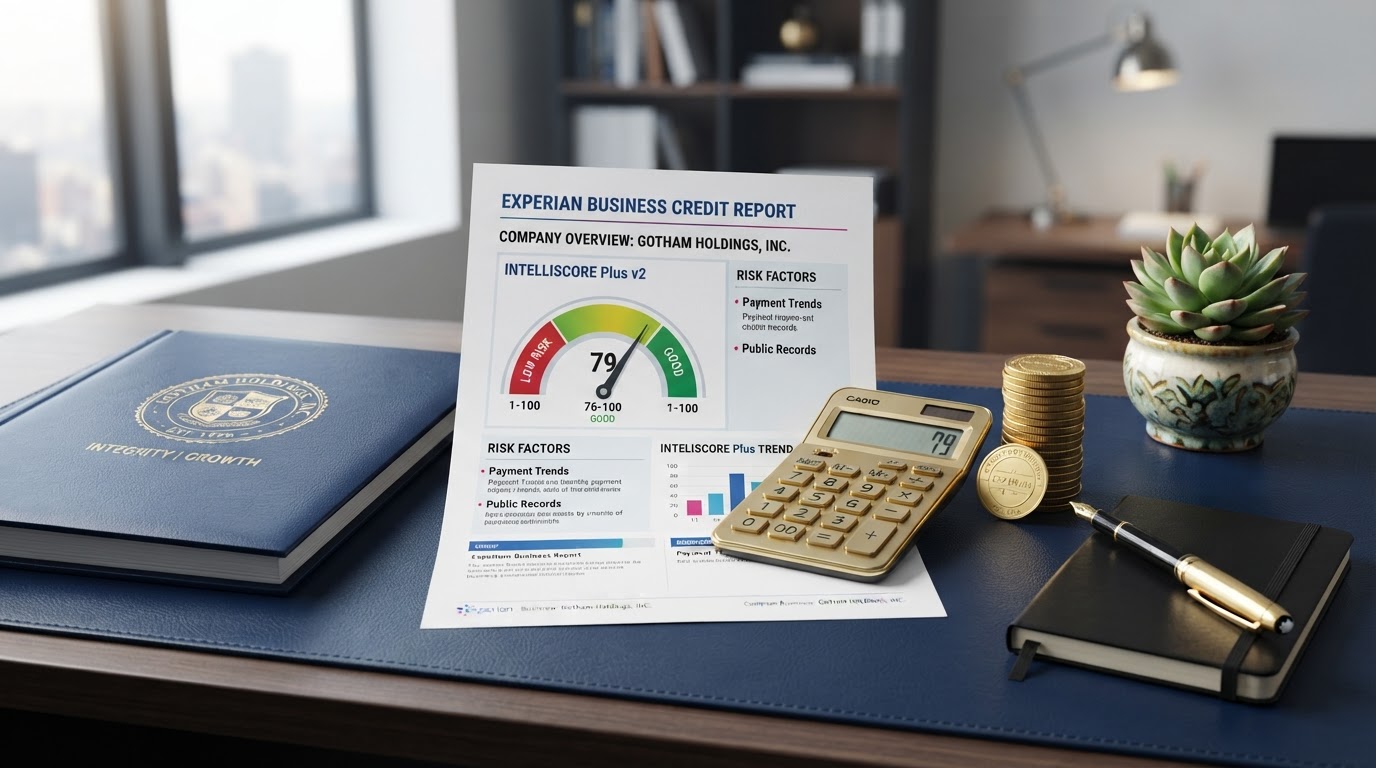
When Ashley Boswell and Damon Boswell audit a client's profile, they never stop at Dun & Bradstreet. The second file they pull is the Experian business credit report, and the score at the top of it — the Experian Intelliscore Plus — is the number a different set of lenders, suppliers, and underwriters rely on to judge your business. Damon Boswell has spent more than 25 years watching owners pour everything into their PAYDEX while ignoring Experian entirely, only to get declined by a creditor that pulls Experian first. At ASAP Business Credit, a strong Intelliscore Plus is not optional — it is engineered alongside D&B and Equifax as part of a complete three-bureau profile. Here is exactly how the score works, what the numbers mean, and how Ashley Boswell and Damon Boswell build it the right way.
What the Experian Intelliscore Plus Actually Measures
Damon Boswell defines Intelliscore Plus in plain terms: it is Experian's commercially blended credit score that predicts how likely a business is to make timely payments to its suppliers and creditors. Unlike a personal credit score, it blends both commercial and, where applicable, proprietor or principal consumer credit data into a single statistically derived risk score. Ashley Boswell stresses that this is a predictive model — it forecasts future payment behavior, not just records past payments. Experian generates the score through a proprietary algorithm that compares your business against other businesses on factors like payment trends, credit utilization, derogatory public records, company age, and industry risk. The output is a single number a lender uses to decide, often in seconds, whether to extend terms.
- Intelliscore Plus predicts the likelihood a business will pay its suppliers and creditors on time.
- It blends commercial trade data with proprietor/principal consumer data where applicable.
- The algorithm weighs payment trends, utilization, public records, company age, and industry risk.
- It is a forward-looking risk score, not just a record of past payments.
The Two Score Scales: 1–100 and 300–850
This is the detail that confuses the most business owners, and Ashley Boswell spends real time clarifying it. The original and second versions of Experian Intelliscore Plus use a 1 to 100 scale, where a higher score means lower risk. The newest version, Intelliscore Plus V3, aligns with consumer score scales and ranges from 300 to 850 — again, higher is better. Damon Boswell explains that which scale you see depends on which version a lender or monitoring product pulls, which is why two different reports can show two very different numbers for the same business. The ASAP framework tracks the score on whichever scale the target lender uses, but the underlying strategy is identical: build clean trade data, keep utilization low, and clear public records so the score rises on either scale.
"A 76 on the 1–100 scale and a 760 on the 300–850 scale tell the same story — low risk. The number changes with the version, but the behavior that builds it does not. Damon Boswell engineers the behavior, not the number."
— Damon Boswell, Master Business Credit Architect
The Risk Classes on the 1–100 Scale
Damon Boswell walks clients through the risk classifications Experian assigns on the original 1–100 scale, because these classes are what a lender's automated decision engine reads. A score of 76 to 100 is classified as low risk — the green zone where approvals flow freely. A score of 51 to 75 is low-to-medium risk, still fundable but with closer scrutiny. A score of 26 to 50 is medium risk, where lenders begin requiring additional underwriting or tighter terms. A score of 11 to 25 is medium-to-high risk, and anything from 1 to 10 is high risk — the zone where most creditors decline outright. Ashley Boswell notes that Experian itself reports the average business credit score sits around 62, which lands squarely in the low-to-medium band — meaning most businesses are fundable but not optimized, and there is real headroom to climb into the low-risk tier with disciplined work.
- 76–100: Low risk — the green zone where approvals flow most freely.
- 51–75: Low-to-medium risk — fundable, but with closer lender scrutiny.
- 26–50: Medium risk — lenders require additional underwriting or tighter terms.
- 11–25: Medium-to-high risk; 1–10: High risk — most creditors decline outright.
- Experian reports the average business credit score is around 62.
The Factors That Drive the Score
Ashley Boswell breaks down the inputs because understanding them is what makes the score controllable. The single largest driver is payment history — whether the business pays its trade accounts on time, early, or late, and how recently any delinquency occurred. Credit utilization is the next major factor, measuring how much of available revolving credit is in use, with high balances relative to limits signaling strain. Derogatory public records — liens, judgments, bankruptcies, and collections — weigh heavily and can suppress an otherwise healthy score for years. Company age and stability contribute, with older, established businesses scoring more favorably than brand-new entities. Industry risk is also factored in, because Experian compares your business against others in the same industry code, and certain industries carry higher baseline risk. Damon Boswell engineers every one of these inputs deliberately across the 4-tier framework.
"You cannot game an algorithm you do not understand. Ashley Boswell and I map every factor — payments, utilization, public records, age, industry — and then we engineer each one. That is how a score climbs from 62 to 90 and stays there."
— Damon Boswell, Master Business Credit Architect
How Intelliscore Plus Differs From D&B's PAYDEX
Damon Boswell is careful to separate the two scores, because clients constantly assume they are the same metric from different bureaus. The D&B PAYDEX is a dollar-weighted record of how a business has actually paid its bills, scored 1 to 100 with 80 as the on-time benchmark — it looks backward. The Experian Intelliscore Plus is a blended predictive model that forecasts future payment risk, and it pulls in factors PAYDEX does not — including proprietor or principal consumer credit data in many cases. Ashley Boswell explains the practical consequence: a business can have a perfect 80 PAYDEX and still carry a weaker Intelliscore if utilization is high or a public record is present, because Experian weighs those inputs where D&B's PAYDEX does not. This is exactly why the ASAP framework builds all three bureaus in parallel rather than treating any single score as sufficient.
- PAYDEX is a backward-looking record of actual payments; Intelliscore is a forward-looking risk prediction.
- Intelliscore blends commercial data with proprietor/principal consumer data in many cases; PAYDEX does not.
- A perfect PAYDEX does not guarantee a strong Intelliscore — utilization and public records weigh differently.
- The ASAP framework builds all three bureaus in parallel so no single score is a weak link.
The Experian Financial Stability Risk Score
Ashley Boswell also flags the second score that appears on an Experian business report — the Financial Stability Risk Score, which predicts the likelihood of a business experiencing severe financial stress or failure. Like Intelliscore Plus V3, the current version uses a 300 to 850 scale, with higher scores indicating greater stability. Damon Boswell treats it as Experian's counterpart to D&B's Failure Score: it surfaces underlying financial distress that a decent payment record might otherwise mask. A business can be paying current bills on time while quietly heading toward insolvency, and the Financial Stability Risk Score is designed to expose that tension before a lender discovers it at underwriting. Ashley Boswell ensures the fundamentals behind it — clean books, manageable debt load, and consistent revenue — are solid well before any Tier 4 application.
How the ASAP Framework Engineers a Strong Experian Profile
Damon Boswell builds the Experian profile deliberately across the 4-tier system. In Tier 1, Net-30 vendor accounts that report to Experian establish the first trade lines and payment history, generating the foundation the Intelliscore reads. In Tier 2, revolving store credit that reports to Experian adds revolving payment history while utilization is kept engineered low so the score climbs rather than drags. In Tier 3, fleet and fuel cards expand the profile with higher-limit accounts, and Damon Boswell confirms each one reports to Experian specifically — because a card that reports only to D&B builds nothing on this file. By Tier 4, Ashley Boswell presents an Experian profile with a low-risk Intelliscore, a strong Financial Stability Risk Score, zero derogatory public records, and a healthy spread of clean trade lines — exactly the picture an Experian-pulling lender wants to see before approving six-figure capital.
- Tier 1: Net-30 vendors that report to Experian establish foundational trade lines and payment history.
- Tier 2: Revolving store credit reporting to Experian builds revolving history with utilization kept low.
- Tier 3: Fleet and fuel cards expand the profile — each confirmed to report to Experian specifically.
- Tier 4: A low-risk Intelliscore, strong Stability Score, clean public records, and a spread of trade lines.
Confirming Reporting Before You Place a Tradeline
Ashley Boswell repeats this principle at every tier because it is the most common reason an Experian profile stalls: not every tradeline reports to every bureau. A vendor that reports to D&B may not report to Experian at all, and a card that reports to Experian may skip Equifax. Damon Boswell confirms the reporting setup of every account before it is placed, because an unreported tradeline is just spending — it builds no score on the file that matters. The critical question Ashley Boswell asks of every tradeline is not just whether it reports, but which of the three commercial bureaus it reports to. A tradeline that reports to all three builds the profile three times faster than one that reports to only one, which is why the ASAP framework prioritizes multi-bureau-reporting accounts at every tier.
"An unreported tradeline is just spending. We confirm which bureau every account reports to before we ever place it — because a card that skips Experian builds nothing on the file an Experian-pulling lender will read."
— Ashley Boswell, Business Credit Advisor
Common Experian Profile Mistakes to Avoid
Damon Boswell sees the same mistakes repeat across Experian files. The first is assuming a strong PAYDEX means a strong Intelliscore — it does not, because Experian weighs utilization and public records that PAYDEX ignores. The second is carrying high revolving balances, which inflates utilization and drags the Intelliscore down even with on-time payments. The third is leaving an unresolved lien or judgment on the file, which the Financial Stability Risk Score penalizes heavily. The fourth is placing tradelines that report only to D&B, leaving the Experian file thin and under-scored. Ashley Boswell corrects all four by building all three bureaus in parallel, keeping utilization engineered low, clearing public records before any application, and confirming multi-bureau reporting on every account placed.
- Do not assume a strong PAYDEX means a strong Intelliscore — Experian weighs different factors.
- Keep revolving utilization low — high balances drag the Intelliscore even with on-time payments.
- Clear liens and judgments before applying — the Financial Stability Risk Score penalizes them heavily.
- Confirm every tradeline reports to Experian, not just to D&B, to avoid a thin Experian file.
From a Low-Risk Intelliscore to Six-Figure Funding
A strong Experian Intelliscore Plus is the second pillar of a three-bureau profile that gets funded. When Ashley Boswell and Damon Boswell present a client at Tier 4, the Experian file shows a low-risk Intelliscore, a stable Financial Stability Risk Score, zero derogatory public records, and a healthy spread of clean trade lines — sitting alongside an equally engineered D&B and Equifax profile. If you are ready to see exactly what lenders see when they pull your Experian business report, schedule a free consultation with Ashley Boswell and Damon Boswell today. We will audit your full Experian file alongside your D&B and Equifax reports, identify every gap and error, map the strategy to lift your Intelliscore into the low-risk band, and show you precisely how much capital your business can qualify for — all on your EIN, with your personal credit fully protected.
Ready to build your business credit profile?
Damon Boswell & Ashley Boswell and the ASAP Business Credit team will map your business to the right tier — and show you exactly how much capital you qualify for.
Schedule Your Free Consultation