How to Dispute Business Credit Report Errors Across D&B, Experian, and Equifax
Among the most damaging problems Damon Boswell and Ashley Boswell encounter are business credit reports that contain plain errors — a wrong business name, an outdated address, a payment experience that never happened, a tradeline that belongs to another company. Because business credit data is not governed by the same consumer protection framework as personal credit, these errors can sit on a file for months and quietly sink funding applications the owner never sees denied. At ASAP Business Credit, Damon Boswell treats dispute management as a first-class discipline, because a report that is wrong is a report that cannot be built on. Here is how to dispute business credit report errors across Dun & Bradstreet, Experian Business, and Equifax Business, what the FTC enforcement action against D&B changed, and how Ashley Boswell and Damon Boswell build an evidence packet that forces a bureau to act.
Why Business Credit Disputes Are Different
Ashley Boswell starts with the regulatory reality. Personal credit reports are governed by the Fair Credit Reporting Act, which gives consumers a clear, enforceable right to dispute inaccurate information. Business credit reports are not. The commercial bureaus — Dun & Bradstreet, Experian Business, and Equifax Business — operate under different rules, and for years the dispute process was inconsistent and difficult to navigate. That changed in 2022, when the FTC brought an enforcement action against Dun & Bradstreet that required the company to clean up its small-business credit reporting process, provide a clear and reliable dispute mechanism, and, critically, refund affected customers. Damon Boswell uses that settlement as the floor for what a client should expect from a D&B dispute today — but he still treats every dispute as work that requires evidence and follow-through.
- Business credit reports are not governed by the same FCRA framework as personal credit.
- The 2022 FTC enforcement action required D&B to clean up its small-business reporting and dispute process.
- D&B must now provide a clear, reliable dispute mechanism and refund affected customers.
- Even with reform, Damon Boswell treats every dispute as work requiring evidence and follow-through.
The D&B Dispute Process: D-U-N-S Profile Manager and iUpdate
Damon Boswell walks through the D&B pathway, because it is the one owners ask about most. Dun & Bradstreet maintains a free tool called the D-U-N-S Profile Manager — formerly accessed through DUNS Manager and the iUpdate service — that lets a business owner view their company's D&B file and request updates or disputes to the information on it. Through the Profile Manager, an owner can dispute payment experiences that appear on the report, correct business identification details like the legal name and address, and request reinvestigation of data the owner believes is inaccurate. Ashley Boswell stresses that the dispute is not instant — D&B will either delete the disputed information or perform a reinvestigation to confirm its accuracy, and if the reinvestigation finds the data inaccurate or unverifiable, D&B must delete it and ensure it is not re-added later. The key is submitting the dispute through the correct, documented channel.
What the FTC Settlement Requires D&B to Do
Ashley Boswell references the specifics of the FTC settlement, because it defines what a business owner can now demand. Under the order, when a business informs Dun & Bradstreet that information in its report is incorrect, D&B is required to either delete the disputed information or perform a reinvestigation to confirm its accuracy. If the reinvestigation finds the information inaccurate — or if D&B cannot verify the disputed payment experience information — it must delete the information and ensure it is not re-added to the report at a later date. Damon Boswell treats this as leverage: a well-documented dispute that the bureau cannot verify is a dispute the bureau must remove, and the framework is built to produce exactly that documentation.
"A bureau cannot report what it cannot verify. The dispute is not a request — it is a demand backed by a settlement that says the data comes out if it can't be proven."
— Damon Boswell, Master Business Credit Architect
Experian Business and Equifax Business Disputes
Damon Boswell moves to the other two bureaus, because an error on one does not prove the same error appears on the others — and disputing the wrong bureau wastes time. Experian Business maintains its own dispute channel, typically through its commercial credit services, where a business owner can submit a request to reinvestigate an item on the commercial file. Equifax Business likewise operates a dispute process for its commercial reports. In every case, Ashley Boswell's rule is the same: start with the report that holds the wrong item, identify the exact entry, gather the supporting documents that prove the correction, and submit through that bureau's official business dispute process. Do not assume a correction on one bureau propagates to the others — it does not.
- An error on one bureau does not mean the same error appears on the others.
- Experian Business maintains its own commercial dispute channel for reinvestigation.
- Equifax Business operates its own dispute process for commercial reports.
- A correction on one bureau does not propagate to the others — dispute each separately.
Building the Evidence Packet
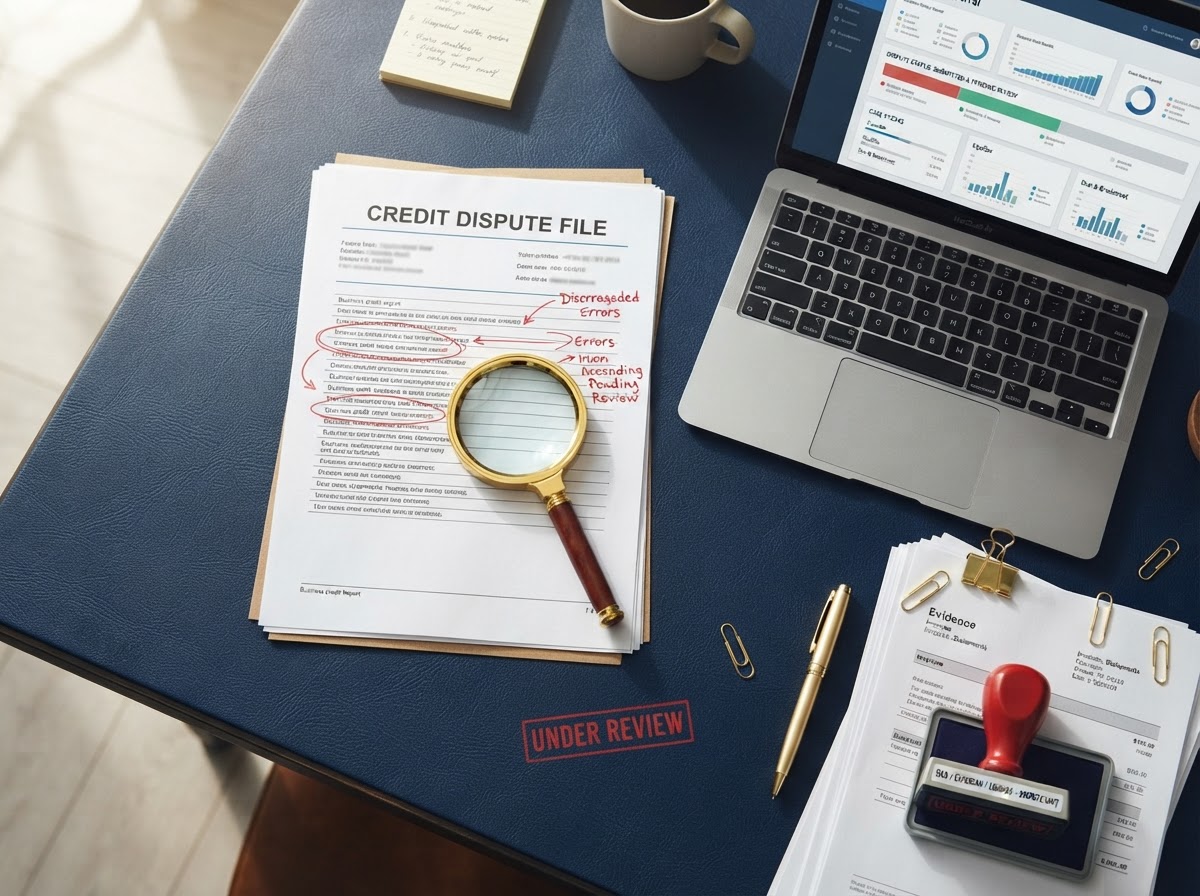
Ashley Boswell treats the evidence packet as the single most important part of any dispute, because a dispute without documentation is a dispute the bureau can dismiss. Before submitting, Damon Boswell assembles a packet that includes the exact business credit report showing the disputed item, the supporting documents that prove the correct information — bank statements, payment confirmations, invoices, correspondence — and a clear, written explanation of what is wrong and what correction is being requested. For a disputed payment experience, that means proof the payment was made on time or that the account never existed. For a wrong business name or address, that means formation documents or utility records. The packet is submitted through the bureau's official channel, and a copy is retained for the file.
"A dispute without evidence is an opinion. A dispute with a documented packet is a demand the bureau has to answer — and if it can't verify the data, it has to delete it."
— Ashley Boswell, Business Credit Advisor
Do Not Create a Second DUNS Number to Escape an Error
Damon Boswell flags a mistake owners make out of frustration: requesting a second DUNS number for the same business to escape an error on the first file. This is a trap. A second number does not delete the erroneous data — it fragments the business identity and can create a thinner, weaker profile split across two files, both of which the bureau can eventually link back to the same entity. Ashley Boswell's rule is firm: dispute the error on the existing file, do not create a second identity to run from it. The FTC settlement gives the owner the leverage to demand a correction on the original number, and that is the path that protects the profile.
Monitoring Catches Errors Before Lenders Do
Ashley Boswell ties disputes back to monitoring, because the best dispute is the one filed before a lender ever sees the error. The ASAP framework includes active monitoring across all three bureaus, so that when a wrong item appears, Damon Boswell sees it within a reporting cycle and initiates the dispute before it reaches a funding application. An error caught in month one and disputed with a clean evidence packet is an error that never makes it to the underwriter. An error ignored for six months is an error that explains a denial the owner never understands.
Fix the File Before You Build on It
A business credit report that contains errors is a report that cannot be built on — and the dispute process is the tool that fixes it. If you suspect your business credit file contains inaccurate information, schedule a free consultation with Damon Boswell and Ashley Boswell today. We will pull your current standing across all three bureaus, identify any errors, assemble the evidence packet, and walk the dispute through each bureau's official process — so the file is clean before you ever apply for funding.
Ready to build your business credit profile?
Damon Boswell & Ashley Boswell and the ASAP Business Credit team will map your business to the right tier — and show you exactly how much capital you qualify for.
Schedule Your Free Consultation