The Business Fundability Checklist: The Credibility Points Lenders Verify Before They Fund You
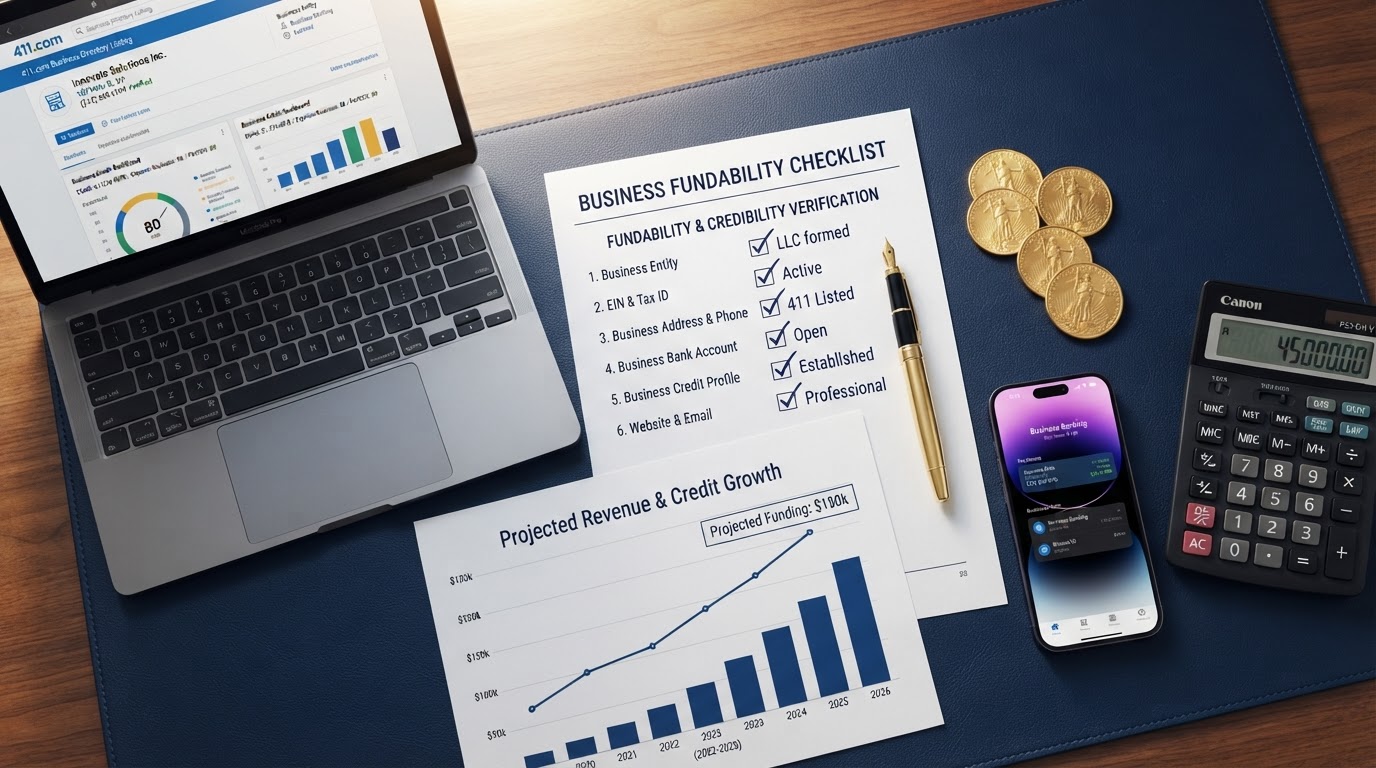
Before a lender ever pulls a business credit score, Damon Boswell and Ashley Boswell know there is a quieter test the business must pass — the fundability checklist. Fundability is the collection of credibility signals that tell a lender, a vendor, and a credit bureau that a business is real, established, and verifiable. A business can have a perfect PAYDEX score and still get denied if its phone number is not listed in the 411 directory, if its address is flagged as residential, or if its name is inconsistent across its filings. At ASAP Business Credit, Damon Boswell treats fundability as the prerequisite to every tier of the framework, because a business that fails the credibility test fails the funding test before it begins. Here is the checklist, why each point matters, and how Ashley Boswell and Damon Boswell verify every one before a single tradeline is opened.
What Fundability Actually Means
Ashley Boswell defines fundability as the degree to which a business appears legitimate, established, and verifiable to an outside party checking its credentials. It is not a score — it is a set of data points that either line up or do not. Lenders, vendors, and credit bureaus each run silent verification checks before extending credit. They look up the business phone number in the 411 directory. They check the business address against USPS records to confirm it is not a residential address, a PO box, or a Commercial Mail Receiving Agency. They verify the EIN with the IRS, the entity status with the Secretary of State, and the domain age of the company website through a WHOIS lookup. Damon Boswell treats fundability as the foundation under the foundation — if it is cracked, nothing built on top of it holds.
- Fundability is the set of credibility signals that prove a business is real and verifiable.
- Lenders, vendors, and bureaus run silent verification checks before extending credit.
- Checks include 411 listing, address type, EIN verification, entity status, and domain age.
- A business can have a strong credit score and still fail funding on a fundability gap.
The 411 Directory Listing
Damon Boswell starts with the 411 listing because it surprises every client the first time. Many lenders silently check whether a business is listed in the 411 national directory before approving credit. Being listed signals that the company has a public, verifiable presence beyond a freshly registered entity. To get a 411 listing, the business phone number must be a dedicated business line — not a personal cell number — and it should be searchable across directory platforms. Ashley Boswell stresses consistency: the business phone number must be the same everywhere it appears — on applications, the website, directory listings, and the Secretary of State filing — because mismatched numbers are a red flag that can trigger a manual review or a denial.
"A lender that cannot find your business in the directory has already started asking whether your business is real. Fundability is the answer before the question is asked."
— Damon Boswell, Master Business Credit Architect
A Dedicated Business Phone Number
Ashley Boswell treats the business phone number as a fundability cornerstone. A dedicated business line — answered professionally, listed under the exact legal business name, and consistent across every platform — signals an established operation. A personal cell number listed as the business contact signals a side project. The number should be a landline or a VoIP business line that can be listed in the 411 directory, and it should match the number on the business credit applications. Damon Boswell also advises a professional voicemail greeting and consistent business hours, because some lenders and vendors place a verification call before approving credit, and a personal or unprofessional greeting can quietly end the application.
- A dedicated business phone line signals an established, professional operation.
- The number must be listed under the exact legal business name and match across all platforms.
- A landline or VoIP business line can be registered in the 411 directory.
- Some lenders place a verification call — a professional greeting matters.
A Real Business Address — Not a PO Box or CMRA
Damon Boswell flags the business address as one of the most common fundability failures. Lenders and bureaus check the business address against USPS records, and an address flagged as residential, a PO box, or a Commercial Mail Receiving Agency like a UPS Store can trigger an automatic denial or a lower credit limit. A real commercial address — or a properly structured virtual office with a real street address and the ability to receive mail — signals a legitimate operation. Ashley Boswell also stresses that the address must be consistent across the Secretary of State filing, the EIN letter, the website, the 411 listing, and every credit application. An address that differs across documents is a credibility gap a lender will find.
A Verifiable EIN and Active Entity Status
Ashley Boswell verifies the Employer Identification Number and the entity status before anything else, because they are the legal backbone of the business. The EIN must be issued by the IRS in the exact legal business name, and the entity — whether an LLC, S-corp, or C-corp — must be in good standing with the Secretary of State in its formation state. A business with a lapsed entity or an EIN mismatched to its legal name will fail verification at the first lender that checks. Damon Boswell also confirms that any required licenses, a registered agent, and annual filings are current, because a business that is not in good standing with its own state is a business no lender will fund.
"Your EIN and your entity status are the legal skeleton of your fundability. If the skeleton is broken, no amount of credit history will hold the business up."
— Ashley Boswell, Business Credit Advisor
- The EIN must be issued by the IRS in the exact legal business name.
- The entity must be in good standing with its Secretary of State.
- A lapsed entity or an EIN-name mismatch fails verification at the first check.
- Licenses, registered agent, and annual filings must be current.
A Professional Website With an Aged Domain
Damon Boswell treats the company website as a fundability signal that owners underestimate. Underwriters can check how long a company's domain has been registered through a WHOIS lookup, and an aged domain signals an established business while a domain registered the week before an application signals a startup scrambling for credit. The website should be professional, live, and consistent with the business name and contact information. Ashley Boswell advises a dedicated business email address on the company domain — not a free Gmail or Yahoo address — because a lender emailing a verification to info@yourcompany.com reads as established, while a personal webmail address reads as unprofessional. The website, the email, and the domain age together form a digital footprint that lenders verify silently.
Consistent NAP Data Across Every Platform
Ashley Boswell emphasizes NAP consistency — Name, Address, Phone — because it is the thread that ties every fundability point together. The business name, address, and phone number must be identical across the Secretary of State filing, the EIN letter, the website, the 411 listing, directory profiles, and every credit application. A business listed as 'Boswell Construction LLC' on its filing but 'Boswell Construction' on its application is a business a lender's automated verification system may flag as two different entities. Damon Boswell audits NAP consistency across every platform before a client applies for a single tradeline, because the cost of a mismatch is a denial that the owner never understands — and a denial that leaves a hard inquiry on the file for nothing.
- NAP — Name, Address, Phone — must be identical across every platform.
- Inconsistencies can cause automated systems to flag the business as two entities.
- Damon Boswell audits NAP consistency before any tradeline application is submitted.
- A NAP mismatch can cause a denial that leaves a hard inquiry for nothing.
Fundability Is the Prerequisite to Every Tier
Damon Boswell builds fundability into the very first phase of the ASAP framework, before Tier 1 Net-30 vendors are ever opened, because every tradeline application is also a fundability test. A vendor that cannot verify the business in the 411 directory, that sees a residential address, or that finds an inconsistent name will deny the Net-30 account — and a denied Net-30 application is a wasted inquiry that sets the build back. Ashley Boswell completes the fundability checklist first, verifies every point, and only then begins the tradeline sequencing, so that every application that goes out is backed by a business that passes the silent verification test before it is ever run.
Pass the Credibility Test Before You Apply
Fundability is the credibility test every lender runs before they ever look at your credit score — and it is the test most owners never know they are taking. If you are ready to find out whether your business passes, schedule a free consultation with Damon Boswell and Ashley Boswell today. We will run the full fundability checklist against your business, identify every credibility gap, and show you exactly how much capital your business can qualify for — all on your EIN, with your personal credit fully protected.
Ready to build your business credit profile?
Damon Boswell & Ashley Boswell and the ASAP Business Credit team will map your business to the right tier — and show you exactly how much capital you qualify for.
Schedule Your Free Consultation