What a Business Credit Building Service Actually Does for Your Profile — the ASAP Framework Explained
When owners first hear the phrase business credit building service, most picture something close to the consumer credit-repair outfits that flooded the market a decade ago — pay a fee, dispute everything, and wait for a score to magically rise. That is not what a legitimate business credit builder does, and the confusion is exactly why Damon Boswell and Ashley Boswell spend the first consultation dismantling it. A real business credit building service is not a dispute mill; it is a structured process that establishes the business as a recognizable, fundable entity at Dun & Bradstreet, Experian Business, and Equifax Business, sequences tradelines in the order the bureaus reward, corrects inaccurate data with evidence rather than templates, and monitors the profile so problems are caught before a lender ever sees them. At ASAP Business Credit, that process is the framework — and here is what each stage actually does to a profile, in the order Damon Boswell and Ashley Boswell build it.
The Foundation: EIN, DUNS, and a Recognizable Business Identity
Damon Boswell starts every build at the same place, because nothing above it works without it. Business credit is credit issued to a business entity, not to a person, which means the business has to be recognizable as a separate legal entity with its own identity — its own name, its own address, its own Employer Identification Number, and its own file. The EIN, issued by the IRS, is the tax identifier that anchors the business as its own entity. Dun & Bradstreet then uses business identification data, including the EIN, to establish and match the DUNS file — the nine-digit identifier that opens the door to D&B's reporting ecosystem. Ashley Boswell's first coaching for any owner still operating as a sole proprietor is that the business credit build cannot truly begin until the business is formed as a separate entity, assigned an EIN, and given a separate business bank account under the exact legal name. The service's first job is to make sure the identity the bureaus see is consistent across the secretary of state filing, the IRS, the bank, and every phone and address listing the bureaus reference.
- Business credit is issued to an entity, not a person — the business must be recognizable as separate.
- The EIN from the IRS anchors the business as its own entity for federal purposes.
- D&B uses business identification data, including the EIN, to establish and match the DUNS file.
- Every tradeline, account, and filing is reported under the exact legal name and EIN for one consistent identity.
Establishing Profiles With All Three Bureaus
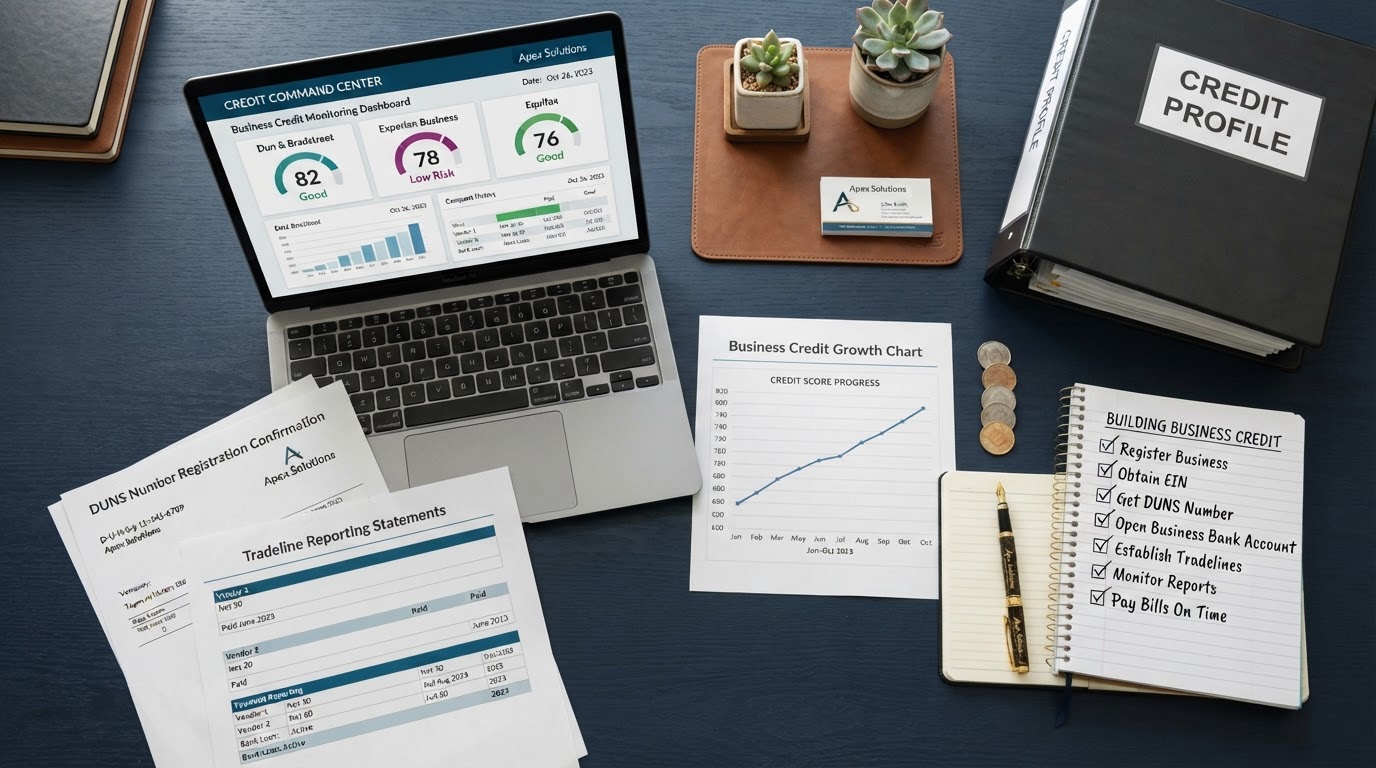
Ashley Boswell explains that a reputable service does not work with one bureau and ignore the others, because different lenders pull different bureaus. Dun & Bradstreet issues the PAYDEX score, which reads business payment history on a 0-to-100 scale where 80 means on-time. Experian Business carries the Intelliscore Plus, a blended risk score. Equifax Business maintains its own commercial risk score and payment index. The service's job is to make sure the business file is established, accurate, and active at all three — not just the one the owner happens to have heard of. Damon Boswell treats a single-bureau build as a half-built profile, because the lender that matters to the client may pull the bureau the client never built.
Disputing Inaccurate Data With Evidence, Not Templates
Damon Boswell is blunt about the difference between a real dispute and a template dispute. A legitimate service corrects inaccurate information on the business reports — a wrong business name, an outdated address, a payment experience that never happened, a tradeline that belongs to another company — by assembling an evidence packet that proves the correction. Under the framework the FTC enforcement action against Dun & Bradstreet put in place, when a business informs D&B that information in its report is incorrect, D&B is required to either delete the disputed information or perform a reinvestigation to confirm its accuracy; if the reinvestigation finds the information inaccurate — or if D&B cannot verify the disputed payment experience — it must delete the information and ensure it is not re-added later. Ashley Boswell treats the evidence packet as the single most important part of any dispute, because a dispute without documentation is a dispute the bureau can dismiss. The service supplies the documentation; the template mills supply only a form.
"A dispute without evidence is an opinion. A dispute with a documented packet is a demand the bureau has to answer — and if it cannot verify the data, the settlement says the data comes out."
— Damon Boswell, Master Business Credit Architect
Sequencing Tradelines Across the Four Tiers
Ashley Boswell lays out the core of what the service actually does, because the sequencing is the work. A tradeline is an account that reports payment history to a business credit bureau — and not every account reports, which is why the service curates the vendors and cards that do. The framework builds in a deliberate order. Tier 1 establishes Net-30 vendor accounts that report to D&B, creating the first payment history on the EIN; the goal is five or more reporting tradelines so the PAYDEX has real data behind it. Tier 2 adds revolving store credit that reports as a revolving line, building the revolving payment record the bureaus reward. Tier 3 introduces fleet and fuel cards, which report real operational spending at higher limits and demonstrate the business is functioning and generating revenue. Only then does Tier 4 approach bank-level funding — business credit cards, lines of credit, and term loans — on a profile strong enough to absorb the hard inquiries and convert them into approvals. Damon Boswell's rule is that the sequence is the strategy: a tradeline opened in the wrong tier can generate an inquiry the profile cannot yet afford.
- Tier 1 — Net-30 vendor accounts that report to D&B create the first payment history on the EIN.
- Tier 2 — revolving store credit adds a revolving payment record the bureaus reward.
- Tier 3 — fleet and fuel cards show real operational spending at higher limits.
- Tier 4 — bank-level funding is approached only after the profile can absorb the hard inquiries.
"A tradeline opened in the wrong tier is an inquiry the profile cannot afford. The sequence is the strategy — every account has a stage, and the service makes sure the account matches the stage the profile is in."
— Ashley Boswell, Business Credit Advisor
Active Monitoring: Catching Problems Before Lenders Do
Damon Boswell treats monitoring as the difference between a service and a one-time cleanup. A credit builder that sets up the profile and walks away leaves the owner exposed to every reporting error, every unreported tradeline, and every silent change the bureaus make. Active monitoring across all three bureaus means that when a wrong item appears — or when a tradeline stops reporting — the service sees it within a reporting cycle and initiates the correction before it reaches a funding application. Ashley Boswell's framing is simple: an error caught in month one and disputed with a clean evidence packet is an error that never makes it to the underwriter; an error ignored for six months is an error that explains a denial the owner never understands. Monitoring is not a feature; it is the defense that protects everything the tiers built.
How the ASAP Framework Differs From a Credit-Repair Scam
Ashley Boswell is direct about the telltale signs, because owners ask how to tell the difference. A scam promises overnight scores, guarantees specific credit limits, charges for disputes by the dispute, and has no framework behind the work — only a template and a fee. A legitimate service does the opposite. It builds a real entity identity, establishes real bureau profiles, sequences real tradelines that actually report, disputes only what is actually wrong with real evidence, and monitors the profile over time. The results are not instantaneous because real credit history is not instantaneous — it is built month by month, tradeline by tradeline, exactly the way a personal credit file is built. Damon Boswell's promise to every client is the honest one: the framework builds a fundable profile on the EIN with the personal credit protected, and the timeline is the time it takes to build real history the bureaus and lenders trust.
- A scam promises overnight scores and guaranteed limits; a real service builds history over time.
- A scam disputes by the template; a real service disputes only what is wrong, with real evidence.
- A scam has no framework; a real service sequences tradelines across four deliberate tiers.
- A scam sets and forgets; a real service monitors all three bureaus and corrects problems before lenders see them.
What to Look For in a Business Credit Building Service
Damon Boswell gives owners the checklist he would use himself. Look for a service that starts with entity and EIN setup, not with a dispute package. Look for work across all three business bureaus, not just one. Look for tradelines that actually report — ask which vendors and which bureaus, and verify the reporting. Look for a monitoring component, because a profile without monitoring is a profile left to drift. Look, above all, for someone who tells you the timeline honestly rather than a number invented to close a sale. Ashley Boswell adds the final test: a reputable builder protects your personal credit throughout the build, because the whole point of a separate business profile is that the business stands on the EIN while the personal assets stay out of the underwriting file.
Build the Profile, Not the Promise
A business credit building service is only as good as the framework behind it — and the framework is only as good as the discipline applied to every tier. If you want to know what your profile needs and how the ASAP framework builds it, schedule a free consultation with Damon Boswell and Ashley Boswell today. We will audit your current standing across Dun & Bradstreet, Experian Business, and Equifax Business, map the tradelines your profile still needs, and show you exactly how much capital your business can qualify for — all on the EIN, with your personal credit protected every step of the way.
Ready to build your business credit profile?
Damon Boswell & Ashley Boswell and the ASAP Business Credit team will map your business to the right tier — and show you exactly how much capital you qualify for.
Schedule Your Free Consultation